Tag: materials_intermediate

  • 50 Gerunds and Infinitives Conversation Questions (PDF)

    50 Gerunds and Infinitives Conversation Questions (PDF)

    Here’s a list with conversation/speaking questions for your English lesson to practice the use of Gerunds and Infinitives:

    • Do you enjoy ______ (travel) to new places?
    • What do you avoid ______ (do) on weekends?
    • Have you ever forgotten ______ (turn off) the stove?
    • Is there anything you can’t afford ______ (buy) right now?
    • What is the best way ______ (learn) a new language?
    • Do you ever go to the park ______ (relax)?
    • What do you recommend ______ (see) in your hometown?
    • Have you finished ______ (read) any good books lately?
    • Is there anything you hate ______ (do) but have to do anyway?
    • Do you hope ______ (visit) any foreign countries next year?
    • What is the hardest thing about ______ (live) in a big city?
    • Have you ever regretted ______ (not study) harder in school?
    • Is there anything you would like ______ (learn) how to do?
    • Do you ever go ______ (hike) in the mountains?
    • What do you suggest ______ (order) at your favorite restaurant?
    • Have you managed ______ (save) much money this year?
    • Is there anything you miss ______ (do) from your childhood?
    • Do you prefer ______ (stay) home or ______ (go) out on weekends?
    • What seems ______ (be) the best way to make new friends?
    • Have you volunteered ______ (help) any charities recently?
    • Is there anything you can’t help ______ (do) when you’re stressed?
    • Do you look forward to ______ (go) to work every day?
    • What do you find difficult about ______ (make) decisions?
    • Have you had a chance ______ (travel) much this year?
    • Is there anything you would hate ______ (lose)?
    • Do you know how ______ (cook) any traditional dishes from your country?
    • What do you like ______ (do) to relax after a long day?
    • Have you ever pretended ______ (be) sick to miss work or school?
    • Is there anything you would love ______ (be) able to do?
    • Do you think it’s important ______ (exercise) every day?
    • What do you need ______ (buy) at the grocery store this week?
    • Have you ever offered ______ (help) a stranger?
    • Is there anything you would refuse ______ (do) for money?
    • Do you spend a lot of time ______ (watch) TV?
    • What is something you want ______ (achieve) in the next 5 years?
    • Have you ever waited a long time ______ (see) a doctor?
    • Is there anything you would like ______ (change) about yourself?
    • Do you ever go ______ (shop) just for fun?
    • What are you afraid of ______ (lose)?
    • Have you agreed ______ (help) your friend move?
    • Is there anything you can’t imagine ______ (do)?
    • Do you feel like ______ (go) to the beach this weekend?
    • What do you dislike ______ (spend) money on?
    • Have you ever failed ______ (pass) an important test?
    • Is there anything you would hate ______ (have) to do every day?
    • Do you know anyone who claims ______ (be) able to predict the future?
    • What do you find easy ______ (do) that other people find difficult?
    • Have you ever forgotten ______ (bring) your wallet to a store?
    • Is there anything you would like ______ (invent)?
    • Do you think it’s wrong ______ (tell) a lie to protect someone’s feelings?

  • 66 Mixed Conditionals Conversation Questions (PDF)

    66 Mixed Conditionals Conversation Questions (PDF)

    Mixed Conditionals Conversation Questions

    Here’s a list with mixed conditional conversation/speaking questions for your English lesson:

    3rd and 2nd Mixed Conditionals Conversation Questions

    Structure: If + Past Perfect, … would + infinitive

    Meaning: A hypothetical past situation with present consequences

    1. If you had pursued your childhood dream career, how would your life be different now?
    2. If you had been born in another country, which culture would you find most fascinating?
    3. If you hadn’t met your closest friend, how would your social life have changed?
    4. If you had learned a musical instrument as a child, which one would you be most passionate about playing now?
    5. If you had chosen a different college major, what career path would you be on today?
    6. If you hadn’t faced your biggest fear, how would your confidence level be affected?
    7. If you had grown up in a different family, what values would you hold most dear?
    8. If you had started learning a foreign language earlier, which one would you be fluent in now?
    9. If you hadn’t read your favorite book, how would your perspective on life be different?
    10. If you had been born in a different era, which historical figure would you want to meet?
    11. If you had taken a gap year before starting your career, what experiences would you have sought?
    12. If you hadn’t moved to your current city, where would you be living and why?
    13. If you had chosen a different hobby to pursue, which one would you excel at now?
    14. If you had been raised by a single parent, how would your family dynamics be different?
    15. If you had grown up with/without siblings, how would your personality have been influenced?
    16. If you had studied abroad during college, which country would have impacted you the most?
    17. If you hadn’t faced a significant setback, what lessons would you have failed to learn?
    18. If you had been born into royalty, what kind of leader would you be?
    19. If you hadn’t taken that risk in your career, where would you be professionally?
    20. If you had grown up in a rural area, how would your appreciation for nature be different?
    21. If you hadn’t met your mentor, what direction would your life have taken?
    22. If you had been given a different name at birth, how would your identity have changed?
    23. If you hadn’t learned the importance of self-care, how would your mental health be affected?
    24. If you had discovered your hidden talent earlier, how would you be using it to make a difference?
    25. If you had grown up in a family that prioritized art and creativity, what kind of artist would you be today?
    26. If you had invested in a different stock market sector last year, how would your financial situation be different now?

    2nd and 3rd Mixed Conditionals Conversation Questions

    Structure: If + Past Simple/were, … would have + past participle

    Meaning: A hypothetical present situation with past consequences

    1. If you were more adventurous, what risks would you have taken in your youth?
    2. If you had more free time now, which opportunities would you have seized in the past?
    3. If you were better at managing stress, how would your health have been affected over the years?
    4. If you spoke another language fluently, which country would you have visited more often?
    5. If you were more outgoing, what connections would you have made at university?
    6. If you had stronger willpower, which bad habits would you have avoided?
    7. If you were living in your dream location, what decisions would you have made differently five years ago?
    8. If you were more financially savvy, what investments would you have made when you were younger?
    9. If you had better time management skills, what goals would you have achieved by now?
    10. If you were more confident in public speaking, what career opportunities would you have pursued?
    11. If you had a better work-life balance, how would your relationships have developed?
    12. If you were more passionate about fitness, how would your body have changed over the years?
    13. If you had more courage to express yourself, what opportunities would you have grabbed?
    14. If you were living closer to your family, how would your childhood memories have been different?
    15. If you had better negotiation skills, what salary increases would you have secured?
    16. If you were more organized, which projects would you have completed years ago?
    17. If you had a different personality type, what friendships would you have formed in high school?
    18. If you were better at saving money, what financial security would you have built by now?
    19. If you had more artistic talent, what creative projects would you have undertaken?
    20. If you were more tech-savvy, which digital opportunities would you have capitalized on earlier?

    Standard 2nd Conditional Questions (for comparison)

    Structure: If + Past Simple/were, … would + infinitive

    Meaning: Hypothetical present or future situations

    1. If you could live in any fictional world, which one would you choose and why?
    2. If you were to write a novel, what genre would it be and what would the plot revolve around?
    3. If you could have any supernatural power, which one would you choose, and how would you use it?
    4. If you were to start your own business, what industry would you focus on and why?
    5. If you could travel back in time, which historical event would you witness?
    6. If you were to learn a new skill, which one would you choose, and how would it benefit your life?
    7. If you could have dinner with any famous person, who would you invite, and what would you discuss?
    8. If you were to create a new invention, what problem would it solve?
    9. If you could live in any country for a year, which one would you pick?
    10. If you were to start a charity, what cause would you support, and how would you raise funds?
    11. If you could have any animal as a pet, which one would you choose, and how would you care for it?
    12. If you were to create a new holiday, what would it celebrate, and how would people observe it?
    13. If you could have any job for a day, which profession would you choose?
    14. If you were to write a song, what theme would it explore, and how would it inspire others?
    15. If you could have any piece of art in your home, which one would you select?
    16. If you were to learn a new language, which one would you choose, and how would it expand your opportunities?
    17. If you could have any famous person as a mentor, who would you pick and what guidance would you seek?
    18. If you were to create a new app, what purpose would it serve?
    19. If you could have any vehicle, which one would you choose, and where would you go on your first adventure?
    20. If you were to take up a new hobby, which one would you pursue, and how would it enrich your life?
    Comparison of Conditional Types – Print Version

    Comparison of Conditional Types

    Type Structure Meaning / Time Reference Example Common Mistake
    Second Conditional
    (for contrast)
    If + Past Simple / were

    … would + infinitive
    Hypothetical present or future situation – unreal or imaginary If I won the lottery, I would travel around the world. Using will instead of would:
    “…If I will win…”
    Mixed Conditional – 3rd → 2nd
    (and common misuse)
    If + Past Perfect,

    … would + infinitive
    Hypothetical past condition with a present result
    Past → Present
    If I had studied harder, I would be successful now. Using would have for a present result:
    “If I had studied harder, I would have been successful now.” ❌
    → Use would + infinitive for a present result.
    Mixed Conditional – 2nd → 3rd
    If + Past Simple / were,

    … would have + past participle
    Hypothetical present condition with a past result
    Present → Past
    If I were more confident, I would have applied for that job. Using Past Perfect in the if-clause:
    “If I had been more confident…” — makes it a standard 3rd conditional, not mixed.
    !

    The tense in the if-clause shows when the condition belongs.

    The tense in the main clause shows when the result is felt.

    📚 Want to Teach This Effectively?

    Looking for lesson plans, activities, and teaching strategies for conditionals? Check out our comprehensive Conditionals Teaching Guide with ready-to-use materials, common student errors, and proven classroom techniques.

    → Access the Free Teaching Guide

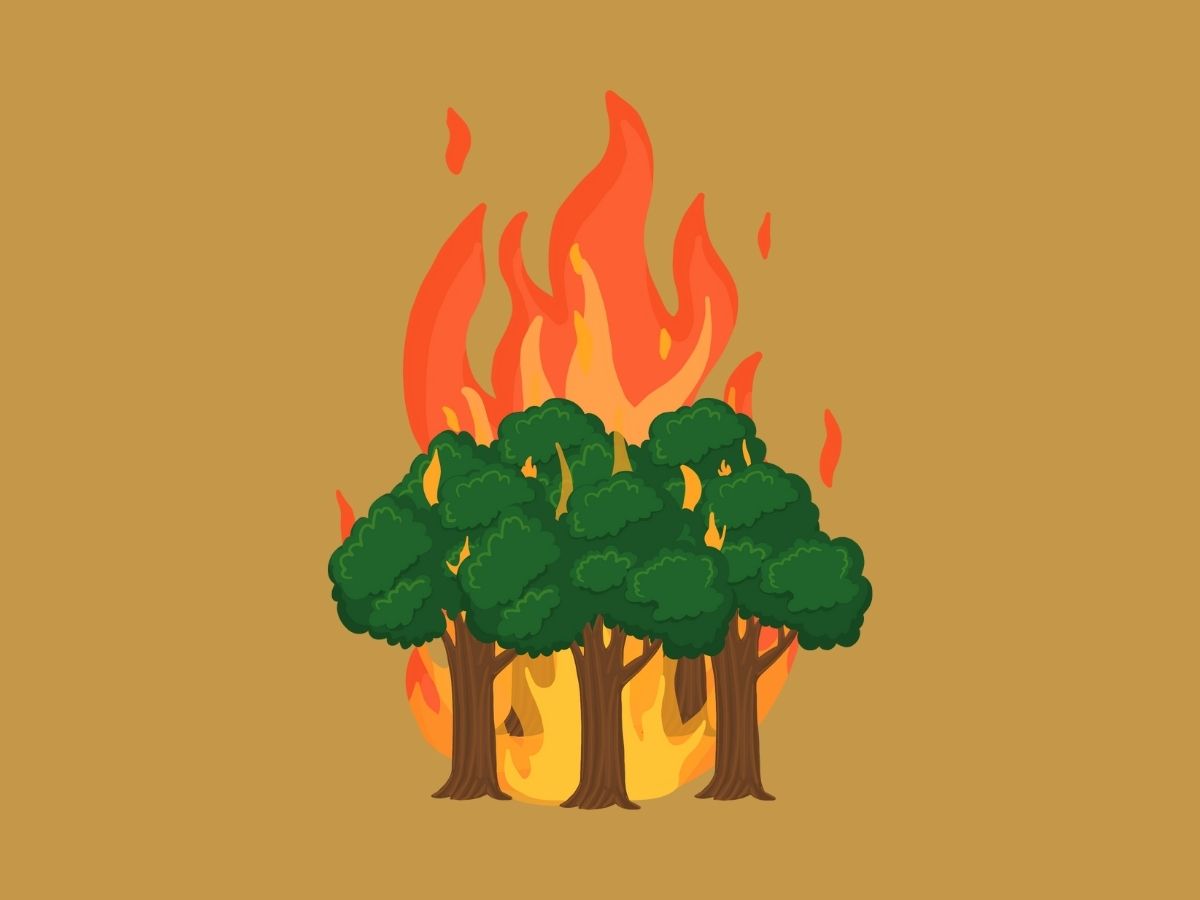
  • The Impact of Wildfires on the Environment (ESL Lesson Plan, Intermediate, ~B1/B2)

    The Impact of Wildfires on the Environment (ESL Lesson Plan, Intermediate, ~B1/B2)

    The Impact of Wildfires on the Environment
    ESL Lesson Plan (Intermediate, B1–B2)

    How to use this lesson plan: The lesson includes a YouTube video and a reading text providing context for the topic. After, you will find listening, reading, grammar, vocabulary, writing, and speaking activities, for upper-intermediate-students. To accommodate different learning needs and styles, alternative exercises are provided for each area, allowing you to customize the lesson by skipping or assigning different exercises to different students. To save time, you can also download the full lesson plan as a ready-to-use PDF, including the answer key and all activities.

    Download the Complete Lesson Plan (Free PDF)

    Download the complete “Impact of Wildfires on the Environment” lesson plan for intermediate (B1–B2) learners — including teacher notes, answer key, and ready-to-use activities.


    Warm-up Activity

    Divide the class into two teams. Explain that you will give them a word related to wildfires, and each team must take turns saying a word that is associated with the given word. The catch is that they cannot repeat a word that has already been said. If a team cannot think of a new word within 5 seconds, the other team scores a point. The team with the most points at the end of the game wins.

    Example:

    • Teacher: The word is “fire.”
    • Team A: Hot
    • Team B: Flames
    • Team A: Smoke
    • Team B: Burn
    • …

    Listening Activity (Video)

    Watch this video:

    Title: Wildfires 101 | National Geographic
    Description: This video by National Geographic explains what wildfires are, how they spread, and their impact on the environment.

    Reading Activity

    Wildfires are uncontrolled fires that burn in natural areas like forests, grasslands, or prairies. They can be caused by human activities, such as campfires or discarded cigarettes, or by natural events like lightning strikes. In recent years, the frequency and intensity of wildfires have increased due to factors such as climate change, drought, and human encroachment on wildlands.

    Wildfires can have significant impacts on the environment. They can destroy habitats and ecosystems, leading to the loss of biodiversity. Many plants and animals may struggle to recover, especially if the fires occur too frequently. Wildfires also release large amounts of carbon dioxide and other greenhouse gases into the atmosphere, contributing to global warming.

    However, not all effects of wildfires are negative. Some ecosystems, such as those found in Australia and the western United States, have adapted to periodic fires and may even require them for seed germination and growth. These controlled burns, when managed properly, can help maintain the health of these ecosystems.

    To minimize the negative impacts of wildfires, it is essential to practice fire safety, such as properly extinguishing campfires and avoiding activities that can cause sparks in dry conditions. Additionally, land management practices like controlled burns and creating fire breaks can help reduce the severity and spread of wildfires when they do occur.


    Comprehension Exercises

    Exercise 1: True or False

    1. Wildfires only occur naturally and cannot be caused by human activities.
    2. The frequency and intensity of wildfires have decreased in recent years.
    3. Wildfires can contribute to the loss of biodiversity by destroying habitats.
    4. All ecosystems are negatively affected by wildfires.

    Exercise 2: Short Answer

    1. What are two potential causes of wildfires?
    2. How can wildfires contribute to global warming?
    3. In what ways can controlled burns be beneficial for some ecosystems?
    4. Mention two ways in which we can minimize the negative impacts of wildfires.

    Grammar Exercises

    Exercise 3: Passive Voice

    Rewrite the following sentences using the passive voice:

    1. Human activities can cause wildfires.
    2. Climate change has increased the frequency and intensity of wildfires.
    3. Wildfires destroy habitats and ecosystems.
    4. Land management practices can reduce the severity of wildfires.

    Exercise 4: Conditionals

    Complete the following sentences using the correct conditional form:

    1. If campfires (not/extinguish) properly, they (can/cause) wildfires.
    2. If we (practice) fire safety, we (minimize) the risk of wildfires.
    3. Ecosystems (recover) more quickly if wildfires (not/occur) too frequently.
    4. If land managers (use) controlled burns, the severity of wildfires (reduce).

    Vocabulary Exercises

    Exercise 5: Matching

    Match the words with their definitions:

    1. encroachment
    2. germination
    3. biodiversity
    4. drought
    5. controlled burn

    Definitions:

    1. the variety of life in a particular habitat or ecosystem
    2. a prolonged period of abnormally low rainfall, leading to a shortage of water
    3. the process by which seeds grow and develop into plants
    4. a fire set intentionally for purposes of forest management, farming, or prairie restoration
    5. intrusion into a territory or domain

    Exercise 6: Fill-in-the-blank

    Complete the sentences with the appropriate word from the list below:

    (intensity, ecosystems, greenhouse gases, frequency, habitats)

    1. Wildfires can destroy animal _____, leading to a loss of biodiversity.
    2. The _____ of wildfires refers to how often they occur over a period of time.
    3. Some _____ have adapted to periodic fires and may benefit from controlled burns.
    4. Wildfires release _____ into the atmosphere, contributing to global warming.
    5. The _____ of a wildfire refers to its severity and the amount of damage it causes.

    Conversation Prompts

    Exercise 7: Debate

    Divide the class into two teams. One team will argue in favor of using controlled burns to manage wildfires, while the other team will argue against this practice. Each team should present their arguments and counterarguments, and the class will vote on the most convincing team.

    Exercise 8: Group Discussion

    In groups of four, imagine you are a team of scientists tasked with developing a new technology to prevent or control wildfires. Discuss potential ideas, considering factors such as effectiveness, environmental impact, and feasibility. Present your best idea to the class and explain why you think it would be successful.

    Writing Prompts

    Exercise 9: Opinion Essay

    In your opinion, what is the most effective way to prevent and manage wildfires? Support your opinion with examples and evidence from the lesson or your own knowledge.

    Exercise 10: Narrative Essay

    Imagine you are a tree in a forest that has just experienced a wildfire. Write a story from the tree’s perspective, describing the events before, during, and after the fire, and how the tree and its ecosystem recover over time.

    Optional Homework Task

    Exercise 11: Research and Presentation

    Research a specific wildfire that has occurred in recent years and its impact on the local environment and communities. Prepare a short presentation (3-5 minutes) to share your findings with the class in the next lesson.


    Vocabulary List

    1. Wildfire (n): A large, uncontrolled fire that burns in a natural area like a forest or grassland.
    2. Encroachment (n): The act of slowly taking over or intruding on something, such as wildlife moving into human areas or humans moving into wild areas.
    3. Frequency (n): How often something happens over a period of time.
    4. Intensity (n): The strength, power, or severity of something.
    5. Biodiversity (n): The variety of living things in a particular area or ecosystem.
    6. Habitat (n): The natural home or environment where a plant or animal usually lives.
    7. Ecosystem (n): A community of living things (plants and animals) and their non-living environment, all interacting together.
    8. Germination (n): The process by which a seed begins to grow and develop into a new plant.
    9. Controlled burn (n): A fire set on purpose under carefully monitored conditions to help manage a forest or other wild area.
    10. Greenhouse gas (n): A gas in the Earth’s atmosphere, such as carbon dioxide, that traps heat and contributes to global warming.
    11. Drought (n): A long period of time with little or no rain, leading to a shortage of water.
    12. Adapt (v): To change or adjust to new conditions or situations.
    13. Extinguish (v): To put out a fire completely.
    14. Minimize (v): To reduce something to the smallest possible amount or degree.
    15. Severity (n): The seriousness or intensity of something undesirable, such as damage or hardship.

    Download the Complete Lesson Plan (Free PDF)

    Bring the topic “The Impact of Wildfires on the Environment” to life with this ready-to-teach ESL lesson plan for intermediate (B1–B2) students.

    This 10-page printable PDF includes:

    • A complete lesson plan with clear teacher instructions
    • Answer key for all exercises
    • Activities covering reading, listening, vocabulary, grammar, speaking, and writing
    • Editable and flexible tasks to suit different classroom needs

    Help your students expand their environmental vocabulary while improving key English skills — all in one engaging, classroom-tested lesson.

    📘 Click below to download your free ESL lesson plan now!

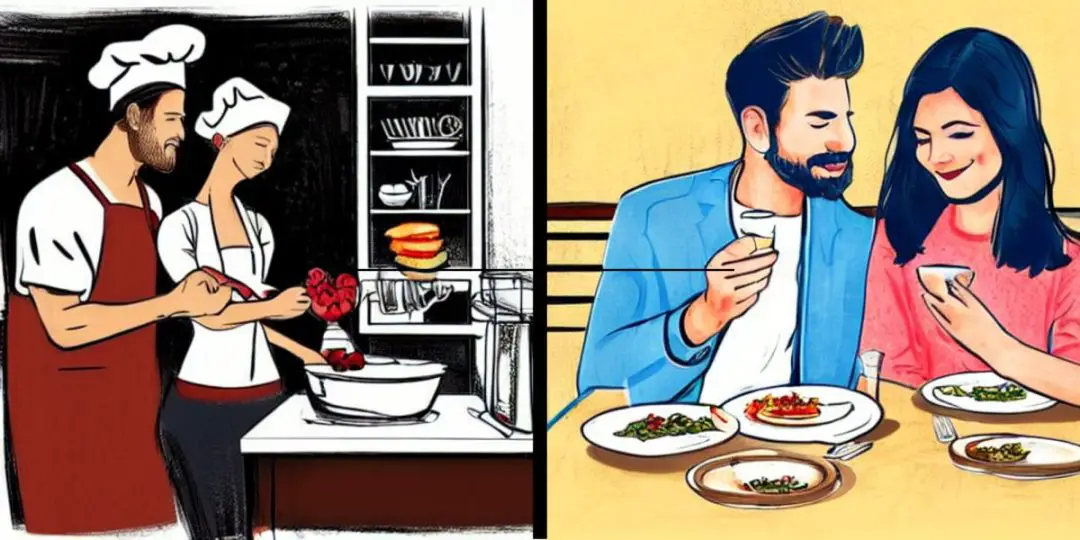
  • Home-Cooked Meals vs. Eating Out (ESL Worksheet and Lesson) (PDF)

    Home-Cooked Meals vs. Eating Out (ESL Worksheet and Lesson) (PDF)

    • Lesson goal: Reading Comprehension, Listening Comprehension, Writing
    • Student level: Intermediate
    • Contents: a 300-word reading text, two exercises with comprehension questions, and an essay writing prompt.

    Reading text

    Preparing meals at home and dining out are two distinct experiences. When you cook your own meals, you have the ability to control the ingredients, the cooking method and the final outcome. You can opt for healthy options, make meals that adhere to your dietary restrictions, or simply create something that tastes amazing. Additionally, cooking at home can be more cost-efficient in the long run.

    Conversely, going out to eat can be a pleasurable and stress-free experience. You don’t have to worry about the cooking or the clean-up, and you get to try new dishes that you may not be able to replicate at home. However, it can be more expensive, and you don’t always know the source of the ingredients or the preparation methods used. Furthermore, restaurant meals may not be as nutritious as home-cooked meals, as they often contain higher levels of fat, salt, and sugar.

    Let the text read aloud to practice listening comprehension:

    Exercise 1: Comprehension Questions (Yes or No)

    Are the following statements correct or incorrect?

    1. Preparing meals at home allows you to have control over the ingredients, cooking method and outcome.
    2. Dining out can be more expensive than cooking at home.
    3. You always know the source of the ingredients and preparation methods when eating out.
    4. It’s easy to adhere to your dietary restrictions when you are eating in a restaurant.
    5. Eating out is always more nutritious than cooking at home.

    Exercise 2: Comprehension Questions (Sentence)

    Answer the following questions with a full sentence.

    1. What are the possible downsides of preparing meals at home?
    2. How can dining out be less stress-free than cooking at home?
    3. Why might eating out be more expensive?
    4. What are the benefits of knowing the source of the ingredients and preparation methods when eating out?
    5. What are the potential downsides of eating out in terms of nutrition?

    Exercise 3: Vocabulary Matching

    Match the following words from the reading text with their definitions:

    1. control
    2. dietary restrictions
    3. cost-efficient
    4. stress-free
    5. ingredients
    6. preparation methods
    7. nutritious

    a. The process of getting ready for a particular purpose or situation
    b. The ability to manage or direct something
    c. not causing or involving stress
    d. The things that are used to make a dish
    e. A set of rules or guidelines that one must follow in order to maintain a healthy diet
    f. not wasting money or resources
    g. containing the right balance of nutrients to maintain good health

    Exercise 4: Essay Writing Prompt

    Weigh the pros and cons of preparing meals at home and dining out in your personal opinion. Explain, what you prefer and why.


    Key for the teacher

    Exercise 1

    1. Yes
    2. Yes
    3. No
    4. No
    5. No

    Exercise 2

    1. Preparing meals at home can be time-consuming and less enjoyable.
    2. Eating out may not be as stress-free as it seems. It can also include waiting in line, dealing with crowds, and making choices from a menu
    3. Eating out can be more expensive because it includes costs such as labour, rent, and energy.
    4. Knowing the source of the ingredients and preparation methods when eating out can help to ensure food safety and to cater for dietary restrictions.
    5. Eating out can be less nutritious as restaurant meals often contain higher levels of fat, salt and sugar than home-cooked meals.

    Exercise 3

    1. b
    2. e
    3. f
    4. c
    5. d
    6. a
    7. g
  • Dialogue/Debate Worksheet: Fast Fashion – The True Cost of Clothes (Intermediate-Advanced)

    Dialogue/Debate Worksheet: Fast Fashion – The True Cost of Clothes (Intermediate-Advanced)

    In this fashion debate worksheet, you are going to find ESL conversation exercises that will help students to discuss and debate on the topic of fast fashion, ethical fashion, and sustainability practices in the fashion industry.

    The worksheet includes a “For and Against” exercise to help students create constructive arguments that would support their stands in the debate. The exercises are tailored to intermediate-advanced (B2-C1) students.

    Preparation Notes for the Teacher

    Required time: 45 min

    To prepare: 

    Discuss the topic of fast fashion and sustainability with your students.

    At the beginning of the class, ask your students if they have heard about the concepts of fast fashion and ethical fashion and if they know the difference between these two. Then, ask students if they have any idea where the clothes they usually buy are produced and how much their clothes really cost to produce?

    Give them a brief introduction on the topic (exploitation of labor, pollution, child labor, consumerism, low quality, non-durable materials). 

    Play the video (embedded below): https://www.youtube.com/watch?v=tLfNUD0-8ts

    Next, make a “For and Against” list together with your students on the topic.

    Instruct students to do Exercise B and C. 

    Finally, divide students into 2 teams and have a “For and Against” debate on the topic “Alternatives to Fast Fashion: A Green Dream of the Near Future?”


    Fast Fashion – The True Cost of Clothes 

    In this worksheet, you will find exercises that will help you learn useful phrases, questions, and conversation tips that you can use when discussing/ debating on topics like fast fashion, ethical fashion, sustainability, etc.

    Think about where do you and most people typically buy clothes, discuss this briefly with your class and your teacher, then answer questions in Exercise A and Exercise B.

    Read the questions before answering to make sure you understand them.

    EXERCISE A. Fast Fashion (For and Against)

    1. Discuss the advantages and disadvantages of fast fashion with your class and teacher, then write them into the table below. Write minimum 5 arguments per column.

    FORAGAINST


    EXERCISE B. True or False?

    2. Watch the video “The true cost of fast fashion | The Economist”, then mark the statements below as True or False.

    1) To tackle throwaway culture, consumers, and brands must change their behaviors.

    2) Only low-class people buy fast fashion clothes.

    3) Rent the Runway tackles the problem with throwaway culture.

    4) Mohammed dislikes the idea of fast fashion.

    5) Rent the Runway rents 20% fast fashion clothes.

    6) Patagonia used to be a fast-fashion brand that turned to sustainability. 

    7) One of Patagonia’s mottos is “Don’t throw it, fix it.”

    8) Savana Rags is a recycling clothes factory.

    9) New York fashionista Ijeoma is mostly interested in high-end fashion.

    10) Most of the 80 billion clothing products go to waste.

    EXERCISE C. Vocabulary

    3. Match the words/ phrases (a-h) to their meanings (1-8).

    a) castoffs
    b) to tackle
    c) unprecedented rate
    d) garments
    e) swanky
    f) to follow suit
    f) hefty
    h) flagship store

    1) Items of clothing
    2) To deal with something in a determined and efficient way
    3) Impressively large or expensive
    4) Something that is no longer wanted (especially a garment)
    5) The lead store in a retail chain as a showcase for the brand.
    6) Stylishly luxurious and expensive
    7) To conform to another’s actions.
    8) Something that is very great in quality, amount or scale.

    EXERCISE D.  Debate/Discussion

    4. Make 2 teams and have a “For and Against” debate on the topic “Alternatives to Fast Fashion: A Green Dream of the Near Future?” Make sure to support each idea with at least one argument.


  • Listening Worksheet: Reported Speech – Harmful Social Media Content (Upper Intermediate-Advanced)

    Listening Worksheet: Reported Speech – Harmful Social Media Content (Upper Intermediate-Advanced)

    In this worksheet about Harmful Social Media Content, you are going to find ESL listening comprehension exercises that will help students to expand their vocabulary on the topic and revise reported speech and its use when reporting news. The exercises are tailored to upper intermediate-advanced (B2-C1) students.

    Preparation Notes for the Teacher

    Required time: 45 min

    To prepare: Discuss social media safety with your students: How much they think of the safety of content they post on social media, do they read the rules and regulations of social media companies when creating an account, do they know how to protect themselves from cyber crime, can they share examples of risks of using social media and unpleasant stories of users?

    Revise the grammar basics of reported speech, then instruct students to answer the vocabulary and grammar questions in warm-up Exercise A.

    Play the video/ audio and instruct students to answer the questions in Exercise B, C and D. 

    Give Exercise E as homework.


    Social Media Companies & Harmful Illegal Content 

    In this listening comprehension technology worksheet, you are going to listen to a 3-minute audio of BBC news on the topic – Social Media Companies and Harmful Illegal Content. 

    The news report on the new laws proposed by the UK government regarding social media companies that will face huge fines if they fail to remove and limit the spread of illegal content.

    Do the warm-up Exercise A first, then answer the questions in Exercise B, C and D.

    Read the questions before answering to make sure you understand them.

    Link to the audio/video: https://www.youtube.com/watch?v=pI8LVHXOSu4

    A. Warm-up (Vocabulary)

    1. Match the words and the expressions to their definitions/meanings.

    to abide

    online grooming

    to face up to something

    to outline

    Lobbying

    criminal prosecution

    Legislation

    a consensus

    to campaign

    urging on
    to confront and deal with a difficult situation

    to trick or force a young person into doing something sexual

    ​​comply with

    the institution and conducting of legal proceedings against someone

    a general agreement

    laws, considered collectively

    work in an organized and active way towards a particular goal

    to seek to influence on an issue

    pleading

    to give a summary of

    B. Warm-up (Reported Speech)

    2. Match the reporting verbs (1-12) to the correct structures; write the numbers in the gaps accordingly. There may be more than one correct structure for each reporting verb. 

    Verbs:

    1) warn2) advice3) notify4) threaten
    5) argue6) admit7) forbid8) urge
    9) wonder10) demand11) refuse12) remind

    Structures:

    somebody that – Verbs: _____________

    somebody to – Verbs: _____________

    that – Verbs: _____________

    who, where, whether, etc. – Verbs: _____________

    to – Verbs: _____________

    +ing – Verbs: _____________

    3. Write the correct words and time expressions (a – l) according to the change by rule in reported speech.

    a) now →

    b) immediately today →

    c) yesterday →

    d) tomorrow →

    e) this week →

    f) last week →

    g) next week →

    h) ago →

    i) here →

    j) come →

    k) come →

    l) bring →

    C. True or False?

    Listen to the audio, then answer the questions.

    Are the statements True or False?

    1. Social media companies received fines for spreading illegal content. _____

    2. Big-tech firms will legally have to provide safety of social media. _____

    3. Frida wonders how long will the legal process take.  _____

    4. Frida urges that she is the only one who is dealing with her case. _____

    5. According to the secretary, YouTube will ban terrorist ideologies. _____

    6. The UK government proposes prosecution of all managers of social media companies. _____

    7. Free speech will be protected by news websites. _____

    8. Ian Russel argues that UK government should have imposed stricter sanctions. _____

    D. Direct to Reported Speech 

    Listen to the audio, then rewrite the sentences in direct speech into reported speech. Do not use “tell” or “say” as reporting verbs.

    1. “These proposals are largely untried and still face huge practical challenges.”

    ___________________

    2. “Social media companies will face very significant fines if they fail to remove spread of illegal content.”

    ___________________

    3. ”Big-tech firms will have to abide by a legal duty of care to protect children.”

    ___________________

    4. “I added him, because you are 13 and just trying to be seen on Facebook, that you’ve got loads of friends and stuff.”

    ___________________

    5. “Who is taking responsibility for this?”

    ___________________

    6. “I’m the only one facing up to what’s happened.”

    ___________________

    7. ”Anti-Semitic hate crime will need to be removed without delay.“

    ___________________

    8. “They could have included sanctions to senior managers upfront and that would have imposed to bring about change.”

    ___________________

     E. Writing 

    Find more news on cybercrime, cyberbullying, or social media safety, then report it to the class.


  • ESL Vocabulary Worksheet: Weather Report & Forecast (Elementary-Intermediate)

    ESL Vocabulary Worksheet: Weather Report & Forecast (Elementary-Intermediate)

    In this weather vocabulary worksheet, you are going to find ESL vocabulary exercises that will help students expand their weather vocabulary and talk and answer questions about seasons, weather, and temperature. The worksheet includes vocabulary exercises on these topics, tailored to elementary – intermediate (A1-B1) students, plus an interactive “Weather Forecast” game/ presentation.

    Preparation Notes for the Teachers

    Required time: 45 – 60 min

    To prepare:

    To warm up, ask your students “What’s the weather like today?” and “What season is it”. Check if they understand the difference between these two and explain it.

    Next, see if they can use more weather adjectives (chilly, cloudy, sunny etc.) by asking “Is it…(chilly, cloudy, sunny etc.)”.

    List flashcards which show different type of weather and weather verbs like “snowing, raining, the sun is shining…”. Give examples: “Today is sunny. The sun is shining. Yesterday was cloud. It was raining.” Encourage students to repeat after you. 

    For Exercise E, play the video to the class, then help them to prepare their weather forecasts and present them in front of the class. Encourage students to use as much of weather vocabulary.


    Weather Report & Forecast

    In this worksheet, you will learn to talk about the weather, the seasons, and the temperature, and then prepare a weather report/weather forecast yourself.

    What’s the weather like today? What season is it? What’s your favorite weather? What do you enjoy doing then? Do you read the weather forecast every day? Discuss briefly with your teacher and the class, then answer the questions in Exercise A, B, C, D. Present your weather forecast to the class.

    Read the questions before answering to make sure you understand them.

    A. Vocabulary (Opposites) 

    1. Choose the words from the table to describe the seasons and write them in the correct column. Some words can be used more than once.

    warm  cold  windy  foggy  icy  sunny  wet  dry  hot  cloudy  snowy  rainy  frosty  clear calm  lovely  terrible  fine  bad
    SPRINGSUMMERAUTUMNWINTER


    2. Write the correct opposite word of the words (a-h) below:

    a) warm – 

    b) hot –

    c) cold – 

    d) foggy –

    e) wet –

    f) windy –

    g) rainy –

    h) clear –

    i) calm –

    j) lovely –

    B. Use of Weather Vocabulary

    3. Read and complete the sentences (a-j) with the words from the table in Exercise A (1).

    a) Let’s go to the beach. It is ___________________ today.

    b) The weather is___________________ today. Put on your raincoat.

    c) The plane can’t fly because it is too ___________________.

    d) I love the winter. It is  ___________________  and  ___________________ and we can ski.

    e) I don’t like the summer. It is too  ___________________ !

    f) The weather is ___________________ . Let’s go to the park!

    g) In autumn, the weather is usually  ___________________ and  ___________________.

    h) My dog likes the spring because it is  ___________________ and we can stay outside and play.

    C. Weather Report (Talking about the Temperature)

    4. Read and answer the questions (a-c).

    NOTE: When we talk about the temperature, we can say:

    • Present: “It is warm today. It is 20°(twenty degrees).”
    • Past: “It was cold yesterday in Canada. It was – 11° (minus eleven degrees).”
    • Future: “It will be hot on Monday. It will be 40° (fourty degrees).”

    a) What was the weather like yesterday?


    b) What’s the temperature today?


    c) What will the weather be like tomorrow?


    Exercise D. Weather Report (Talking about the Temperature)

    5. Now answer the questions about the weather and the temperature in the cities below. 

    LONDON TODAY (WEDNESDAY): 10° SUN 

    TuesdayThursdayFriday
    5° RAIN CLOUDS12° CLOUDS8° SNOW

    a) What is the weather like today?


    b) What will the weather be like tomorrow? What will the temperature be like on Thursday?


    c) What was the weather like yesterday?


    LISBON TODAY (THURSDAY): 35° HOT SUN

    Tuesday ThursdayFriday
    5° (RAIN CLOUDS)12° (CLOUDS WIND)8° (SNOW SUN)

    d) What is the weather like today? What’s the temperature today?


    e) What was the temperature yesterday?


    f) What will the weather be like on Friday?


    Exercise E. Game (Weather Forecast)

    5. Watch this video: https://www.youtube.com/watch?v=gzPA-YKJmVk&t=8s

    Make a weather forecast similar to the one in the video and present it to the class.


  • ESL Writing Worksheet: Opinion Essay About Video Games (Intermediate)

    ESL Writing Worksheet: Opinion Essay About Video Games (Intermediate)

    Opinion Essay About Video Games
    ESL Writing Worksheet (Intermediate, B1)

    In this writing worksheet, you are going to find exercises that will help students elevate their writing skills and practice the structure of an opinion essay on the topic “Are Video Games Good for Youngsters?”. 

    There is an example of a short opinion essay on this topic, plus a multiple section where students can check their understanding of this type of writing, a section for practicing useful words and phrases for opinion essays plus practical tips for writing an opinion essay. The exercises are tailored to intermediate (B1) students.

    Preparation Notes for the Teachers

    Required time: 45 – 60 min

    To prepare:

    Prepare a discussion that covers the topic of the pros of video games. 

    As a warm-up, tell students that you all know that playing too many video games for too long can be harmful for the mental and physical being of a person. However, this activity is also fun and some games are really engaging and intelligently made, so players see many good reasons about why they should play them. 

    Ask students: How many hours per day do they play video games? What is their favorite video game and why? Are video games a good way to socialize? Are video games a good way to learn new English words? Are there any other benefits?


    An Opinion Essay: Are Video Games Good for Youngsters?

    In this worksheet, you will find exercises that will help you strengthen your writing skills and learn how to write an opinion essay on the topic “Are Video Games Good for Youngsters?”.

    You will also learn some useful words and phrases for opinion essays, plus practical tips for writing an opinion essay. 

    What is your favorite video game and why? Are video games a good way to socialize? Are video games a good way to learn new English words? Are there any other benefits?

    Discuss briefly with your teacher and the class, then answer the questions in Exercise A, B, C, D, and E.

    Read the questions before answering to make sure you understand them.

    Are Video Games Good for Youngsters?

    Today, many young people play video games on their electronic devices, at home, at their friends’ houses and many of them say that playing video games is their favorite activity.  These games are good for young people because of several reasons.

    First of all, I think that video games are a good way to train your brain. There are many popular games in which players need to have high levels of thinking, follow instructions, solve complex problems and use logic. In my opinion, these games are fun, and you can learn many things from them. Moreover, you can play them with friends online, so you can hang out and socialize even if you have long-distance friendships.

    In addition, you can learn a lot of new English words if you play video games. Some people think that you learn best in classes and while listening to music or watching films. Although this is true, there are many excellent students who learn English from video games because they spend most of their free time playing.

    Finally, I believe that video games are good because they are fun and intelligent. I think that they are a good alternative to communicate with friends when you can’t see them in person and learn many new things together.

    A. Understanding the Opinion Essay

    1. Read the above essay, then choose and circle the 6 ideas that are mentioned in the essay.

    a) Video games can increase your intelligence and ability to think.

    b) Too many young people are obsessed with video games.

    c) Playing video games online is good for socializing.

    d) You can play video games even when you are not at home.

    e) It is better to learn English in person than online.

    f) Many students do well in English because they play video games.

    g) There more reasons why playing video games is good for young people.

    h) Many video games may help young people with problem-solving.

    B. Expressing Opinion

    2. Match the words and phrases that have a similar meaning. *Reminder: some of these words and phrases are underlined in the opinion essay in Exercise A.

    To sum up…  Today…  Actually…  I don’t think that….  Firstly… Moreover… I think that… To conclude…

    a) I disagree that… ____________________________________

    b) Finally…____________________________________

    c) Nowadays…____________________________________

    d) In addition…____________________________________

    e) In fact…____________________________________

    f) First of all…___________________________________

    g) I believe that…____________________________________

    Tips for Writing an Opinion Essay

    1. Write your essay in 3-4 paragraphs. Start each paragraph with phrases like First, Moreover, To conclude.
    2. Express your opinion using phrases like In my opinion, I believe, I think that. Always support your opinion with 1-2 arguments, i.e., why you think so.
    3. Mention opinions that are different from yours. Use phrases like “Some people think/believe“ and then explain why you don’t agree with them. Always explain why you disagree with 1-2 arguments.

    C. Write an Opinion Essay

    3. Write an opinion essay with the title ‘Are video games good for youngsters?’ Write the essay below and give your opinion.


  • ESL Listening Comprehension Worksheet: Technology and Relationships (Intermediate-Advanced)

    ESL Listening Comprehension Worksheet: Technology and Relationships (Intermediate-Advanced)

    ESL Listening Comprehension Worksheet (B2): Technology & Relationships

    In this listening comprehension worksheet about technology, your students are going to listen to 12 minutes of a podcast titled: “Science Human Connection: Can Technology Help Us Build Authentic and Meaningful Relationships?“. The worksheet contains a warm-up activity and other exercises. It’s tailored to Intermediate-Advanced students (B2).

    Preparation Notes for the Teacher

    Required time: 30 min

    How to use the worksheet: 

    • Play the podcast, pause at minute 3:00.
    • Instruct the students to do warm-up Exercise A. 
    • Play again and pause at minute 12:00. 
    • Instruct the students to answer the questions in Exercise B and Exercise C.

    Link to the podcast:

    https://www.unboxyourworld.com/podcast/episode/2b616e85/science-human-connection-can-technology-build-better-relationships


    Can Technology Build Better Relationships?

    To complete this worksheet, you are going to listen to the first 12 minutes of a podcast titled: “Science Human Connection: Can Technology Help Us Build Authentic and Meaningful Relationships?“

    Link to the podcast: https://www.unboxyourworld.com/podcast/episode/2b616e85/science-human-connection-can-technology-build-better-relationships

    Do the warm-up Exercise A first, then answer the questions in Exercise A and Exercise B.

    Read the questions before answering to make sure you understand them.

    A. Warm-up (Vocabulary) 

    Draw lines to match the words and the expressions on the left to their definitions/meanings on the right.  

    a) a start-up

    b) an algorithm

    c) an insight

    d) to build bridges

    e) a matchmaker

    f) swiping (in an app)

    g) to resonate

    h) meaningful

    i) to pivot

    j) to lag behind
    to relate to a statement or event

    to decline or reject someone

    to move more slowly than others

    to connect for better understanding

    a newly established business

    worthwhile

    to fundamentally change the direction

    a process or set of rules in calculations for problem-solving

    someone who arranges romantic relationships between people

    an accurate and deep understanding

    B. Multiple-Choice Questions 

    Listen and choose the correct letter. (Do not fill in the blanks.)

    1. Before Nina and Niloo met, Nina wanted to start a new business with …

    a) her old colleagues
    b) a dating app founder
    c) a co-founder

    2. Technology has _______ in improving human relationships.

    a) built a community
    b) created dating apps
    c) lagged behind

    3. The matchmaker of Nina and Niloo was …

    a) the HelloIris app
    b) Niloo’s former boss
    c) Nina’s friend

    4. According to Niloo, the blockchain industry can be compared to …

    a) a community
    b) a romantic relationship
    c) human society

    5. Before working together, both Nina and Niloo were tired of apps …

    a) that didn’t match personalities
    b) that were focused on endless swiping
    c) that used complicated algorithms 

    C. True or False?

    Are the statements True or False?

    1. According to Nina, human connection is based on humans’ world-view and communication.  _____

    2. Niloo’s colleague created personality tools that she later used in the HelloIris app. _____

    3. The algorithm for the dating app is based on humans’ reactions and life values, like “I am a vegan”. _____

    4. Swiping apps were an antidote to the HelloIris app. _____

    5. Nina and Niloo started working together after they had met on Facebook. _____

    D. Discussion

    Answer these questions in class and explain your answers with arguments. 

    How effective are dating apps for meeting romantic partners? 

    Do you trust the matchmaking of dating apps? 

    Do you think that technology will progress enough to help humans build quality relationships?

  • ESL Vocabulary & Conversation Worksheet: Job Interview (Intermediate-Advanced)

    ESL Vocabulary & Conversation Worksheet: Job Interview (Intermediate-Advanced)

    In this job interview vocabulary worksheet, you are going to find ESL job interview vocabulary exercises that will help students to learn useful phrases and help them answer questions when attending a job interview. The worksheet also includes a conversation exercise for practical use of the vocabulary. The exercises are tailored to intermediate-advanced (B2-C1) students.

    Preparation Notes for the Teacher

    Required time: 45 min

    Create and print out job cards and interview cards for Exercise C. The job cards contain a job and requirements, while the interview cards contain questions for the jobseeker. Make sure you use the questions from Exercise B, and you are welcome to add more.

    The role-play should be performed in pairs, so make sure you have 3 job cards with 3 matching interview cards per pair.

    Student 1 is the jobseeker who draws a job card, while Student 2 is the employer who asks questions at the interviews. Roles can be swapped for a second round of the role-play activity.


    Job Interview

    In this job interview vocabulary worksheet, you will find job interview vocabulary exercises that will help you learn useful phrases, questions, and conversation tips (what you should and shouldn’t say) that you can use when attending a job interview.

    Think about your dream job and what kind of skills and personality traits you need to have for that job. Discuss this briefly with your class and your teacher, then answer the questions in Exercise A and Exercise B.

    Read the questions before answering to make sure you understand them.

    A. Vocabulary (Skills and Personality Traits)

    1. Imagine that you are a jobseeker. Think about how you would describe yourself. Look at the personality traits table, then check the statements below. Can you recognize the personality traits of every description? Fill in the blanks 1-14 with the correct word from the personality traits table.

    Personality traits:

    directassertivedeterminedobservant
    motivatedreliableproblem-solverupfront 
    people-orientedgoal-orientedpersistentcommunicator
    You…Say this to your employer:
    (fill in one personality trait)
    1always notice when someone needs something at a meetingI am ________________________.
    2don’t quit until you complete your task.I am ________________________.
    3love being around people, working together and helping them.I am ________________________.
    4always carefully plan your tasks for the next week to achieve everything that you want.I am ________________________.
    5know that you have to stay focused and keep on working to be successful.I am ________________________.
    6will never talk about work outside work.I am ________________________.
    7believe that you have to say it out loud when something is wrong.I am ________________________.
    8can talk to anyone.I am ________________________.
    9like finding solutions.I am ________________________.
    10believe that self-confidence is 50% of job success.I am ________________________.
    11see problems at work as challenges.I am ________________________.
    12express your intentions and beliefs clearly.I am ________________________.

    2. Describe yourself briefly as a jobseeker using the words from Exercise A. Give explanations to your statements.

    For example: “I am positive and reliable. When I have problems at work I try to look for a solution and I never share ideas from work outside work.“

     ________________________________________________________________

     ________________________________________________________________

     ________________________________________________________________

     ________________________________________________________________

     ________________________________________________________________

     ________________________________________________________________

    B. Job Interview Questions & Advice

    3. Read the questions (1-8). These questions are typical for a job interview. Match the questions to their correct answers (a-h).

    Questions:

    1) How are you today? Answer: ___

    2) Did you have any trouble finding us? Answer: ___

    3) Can you stick to deadlines? Answer: ___

    4) How much do you expect to earn per month? Answer: ___

    5) What are your strongest points as an employee?  Answer: ___

    6) What languages can you speak fluently? Answer: ___

    7) What are your goals for the future? Answer: ___

    8) Have you got a car license?

    Answers:

    a) I expect my monthly salary to be $10, 000.

    b) English, Farsi, and Norwegian.

    c) I see myself as a CEO of a marketing agency.

    d) No, I only have a motorcycle licence.

    e) Very well, thank you. How about you?

    f) Yes, that is not a problem for me.

    g) No, I used to work in this area.

    h) I am very productive, upfront, and goal-oriented.

    4. Here are some examples on what you should and shouldn’t say at a job interview. Mark each sentence 1-10 as “Right” or “Wrong”.

    1) I really need this job! ___                               

    2) No, I don’t have any questions for you. ___

    3) I can work under pressure because I see challenges in problems. ___

    4) How much will my salary be? ___

    5) With this job, I would like to develop my skills and get more experience in marketing. ___

    6) I feel really anxious. ___

    7) I like to change jobs because I need changes in my life. ___

    8) I really like that you organize after work parties every Friday! ___

    9) My current job is convenient, but I want to upgrade my skills. ___

    10) My goal is to strengthen my skills and learn more about sustainability in architecture. ___

    Exercise C. Speaking (Role-Play)

    5. Do this role-play activity together with your partner, then swap roles:

    Student 1 draws a job card. Student 2 uses a matching interview card for Student 1 for the job on the card.

    Student 2 ask the interview questions from the and Student 1 has to give creative answers to get the job. Act out the interview in front of your class.

    Download this worksheet in Word and PDF doc format (zipped)

  • ESL Lesson Plan: Nature & Environment (Intermediate)

    ESL Lesson Plan: Nature & Environment (Intermediate)

    In this ESL nature worksheet, you will learn and expand the vocabulary of nature and environment. Exercise A contains a vocabulary of landscapes in nature. Exercise B contains a vocabulary of environment and climate change.

    Read the questions before answering to make sure you understand them. 


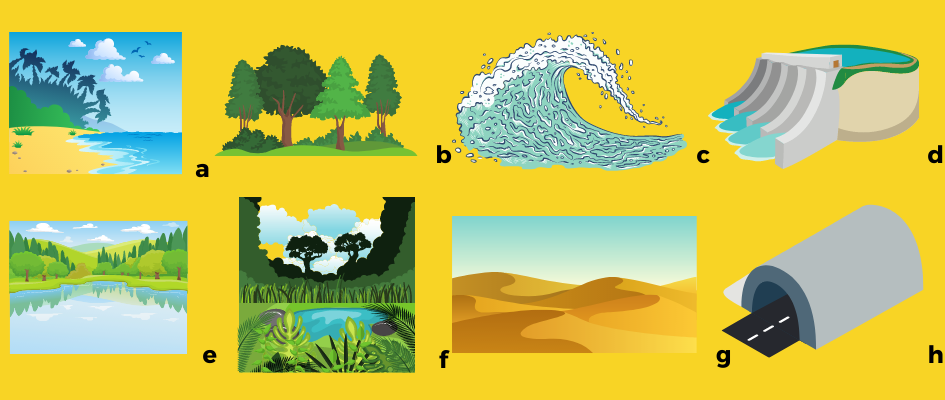
    A. Exercise: Vocabulary (Landscapes)

    1. Match the pictures (a-f) with the correct words (1-6) and fill in the blanks.
    1. desert ___
    2. ocean  ___
    3. rainforest ___
    4. coast ___
    5. forest ___
    6. lake ___
    7. dam ___
    8. tunnel ___

    2.  Read the sentences and fill in the blanks with the correct words from Exercise 1. Please mind that some words need to be written in their plural form.

    a) The Caspian Sea is the biggest ___________ in the world.

    b) Antarctica is the largest polar  ___________ on Earth.

    c) There is always light at the end of the  ___________.

    d) The  ___________ (plural) absorbs CO2 and releases oxygen that humans need to survive.

    e)  ___________ (plural) are important because they provide energy and water for drinking, cooking, bathing, washing, and garden watering.

    f) The Amalfi  ___________ in Italy looks amazing!

    g) Bears, deer and wolves are  ___________ animals.

    h) Every day, people throw 8 million pieces of plastic in our  ___________ (plural).


    B. Exercise: Reading & Translation (Environment) 

    Read the text carefully, then rewrite the underlined words in the “ENG” column in the table below. Translate each word in your language and write the translation in the second column.

    Our planet is in great danger, and we need to protect it because our world is our home, and we must save it! The greatest threats on planet Earth today are climate change, air pollution, water pollution the cutting down of trees, and the extinction of animals and plants. Some zoologists work with animals that are endangered species. These animals are animals that are disappearing from our planet because of climate change, hunting, poaching, and the destruction of their habitat. Many animal species are extinct and this means that they no longer exist, like the male white rhino or the Chinese dolphin. Don’t forget that we are all responsible for the future of our planet, so here are some things that we can do to preserve the natural world: 

    • recycle
    • reuse
    • say no to plastic bags, cups, and bottles
    • travel with trains instead of airplanes
    • eat less meat
    • shop from eco-conscious brands
      ENG (translation) 


    C. Exercise: Questions & Answers 

    Watch the video of the popular climate activist Greta Thunberg. Do you know Greta? Have you heard of her initiative “Fridays for Future?” 

    Talk briefly together with your class and teacher about why is she important, then mark questions 1-6 as True (T) or False (F).

    1. Students protest to save the environment. ____
    2. Greta thinks that we can’t fix climate change. ____
    3. We need to stop burning fossil fuels. ____
    4. Trees and coral reefs can’t help us to repair our broken climate.____
    5. Up to 200 species are going extinct every single day. ____
    6. Nature can’t regenerate. ____

    D. Activity: Memo Game

    Review the landscape and the environment vocabulary. Then put this worksheet away and play the game in teams. The winner is the team who will answer most questions in record time.

    Download this worksheet in Word and PDF doc format (zipped)

  • ESL Grammar Worksheet, Future Tenses: Traveling (Intermediate-Advanced)

    ESL Grammar Worksheet, Future Tenses: Traveling (Intermediate-Advanced)

    In this grammar worksheet, you are going to find ESL future tense exercises for revising the future tenses and a conversation exercise for practical use of the future tenses when talking about travel.

    Read the questions before answering to make sure you understand them. 

    A. Revision 

    Look at the definitions and rules of each future tense, then write your own examples in the blank spaces.

    FUTURE SIMPLE

    We use Future Simple for promises, offers, and predictions. 

    • Promises: I won’t forget to send you the vacation photos.
    • Offers: I will call them when I arrive.
    • Predictions: Electric vehicles will become more affordable in the next few years.

    1.


    2.


    3.


    GOING TO

    We use the ‘going to’ form for predictions when there are signs that something will happen in the near future and for future plans or intentions that were made in advance.

    • Predictions: Your bank account is blocked. You are going to have to call the bank officials.
    • Future plans or intentions: I am going to hitchhike in Hong Kong next year.

              1.


              2.


    FUTURE CONTINUOUS

    We use the Future Continuous when we are in the middle of doing something at a certain point in the future.

    • Text me at noon, because I’ll be flying in the morning.
    • They won’t be serving food this evening at the hotel.
    • At 9:00 tomorrow morning, he’ll be on the train to Amalfi Coast.

    1.


    2.


    3.


    FUTURE PERFECT

    We use Future Perfect when a certain action will happen between now and a point in the future.

    • My son will have traveled all the 7 continents before I turn 50.
    • By the time we arrive in Venice, their dinner in the hotel will have finished already.
    • His parents will have visited 500 museums by 2030.

    1.       


    2.


    3.


    FUTURE PERFECT CONTINUOUS

    We use Future Perfect Continuous for actions that will continue to happen up to a certain point in the future.

    • By 5 AM, I will have been preparing meals for the passengers for 3 hours already.
    • By the time she finishes her journey, she will have been traveling for 3 years.
    • By this time next year, her mother will have been climbing in the Himalayas for a month.

    1.       


    2.


    3.       


    PRESENT CONTINUOUS FOR EXPRESSING FUTURE

    We use the Present Continous to talk about future arrangements, i.e. plans that one has decided and organized with another person.

    • I’m spending my summer holiday with my aunt at her lake house.
    • I’m flying to Rome at 3 o’clock tomorrow afternoon.

    1.       


    2.


    PRESENT SIMPLE FOR EXPRESSING FUTURE

    We use the Present Simple to indicate that an event is scheduled in the future (transport, entertainment, meeting).

    • The cocktail bar in the lobby opens at 6 pm.
    • The train to Stockholm leaves at 10 pm.

    1.       


    2.


    B. Future forms (grammar)

    Choose the correct future form to complete the sentences ( 1-10)

    1. The boarding queue is very long. We _________________ (wait).
    2. Ah, I spilled the coffee. I _________________ (call) the flight attendant and ask for paper towels.
    3. Axel _________________(go) Anna’s new mountain cottage in the Alps for the first time tomorrow evening.
    4. ‘I didn’t bring my bathing suit.’‘Relax, I _________________(borrow) you! I brought two pairs and one of them is brand new. You can have it!”
    5. By the end of the year, she _________________(sail) the Atlantic for 3 years.
    6. I _________________ (fly) at 8 am tomorrow because my hotel booking is on the sam day.
    7. When you arrive at the airport, we _________________ (take) a PCR test in the airport clinic.
    8. ‘I _________________(write) to you every day.’
    9. Air traveling _________________ (be) continue to be one of the greatest issues in the climate catastrophe.
    10.  When Emma retires next week, she _________________ (work) in the tourist agency for over 30 years.
    11. Please tell the hotel reception to wake you up in the morning, because I _________________ (sleep).
    12. _________________(go) to the beach party tonight? 
    13. Who do you think _________________ (win) the free tickets to Mallorca?
    14. Look at the waves! We _________________ (crash)!
    15. I’m sure that before we turn 50, the tourism industry _________________ (invent) revolutionary holographic sightseeing.
    16. The city tours _________________ (schedule) at 8 in the morning.
    17. Breakfast_________________ (start) at 7 am.
    18. You look like you’re having jet lag. Shall I _________________ (get) you a cup of coffee?
    19. The bus _________________ (leave) at 3 pm. Don’t be late!
    20. When she goes to Amsterdam next month, she _________________ (stay) at the friends of her mother’s.

    C. Let’s Talk About the Future (Conversation Game)

    Draw a slip of paper. Talk for 30 seconds and try to say as many sentences that express future tense. The winner is the person who will have the highest number of sentences by the end of all rounds. 

  • ESL Vocabulary Worksheet: Let’s Go Shopping (Elementary-Intermediate)

    ESL Vocabulary Worksheet: Let’s Go Shopping (Elementary-Intermediate)

    You are going to learn about the types of shops and how to communicate when you go shopping.

    Think about the last time you entered a shop and the things you bought. What shop was it? What did you buy? Share briefly with the class, then do exercises A, B, and C.

    A. Exercise: Vocabulary

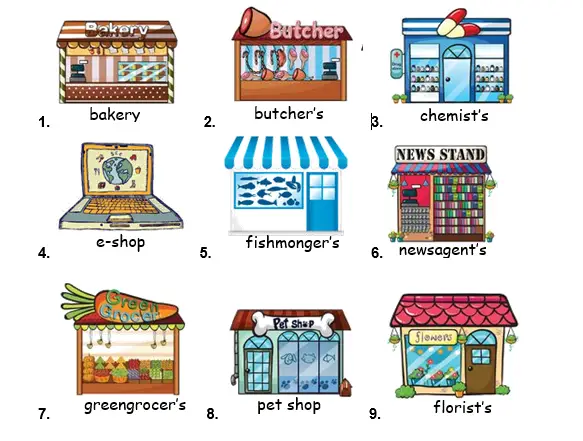
    Match images (1-9) with the correct words (A-I), then fill in the gaps.

    A.croissant___            B.acquarium___         C.aspirin___       D.internet___ E.bouquet___ F. watermelon___       G.tuna fillet___           H.meatballs___           I.magazine___                    

    Fill in the gaps of the sentences with the correct words from the above exercise.

    1. If you want to buy ____________, you have to go to the florist’s.
    2. We don’t have that dress in the shop, but you can order it from our ____________.
    3. Let’s buy a croissant with apricot jam from the  ____________.
    4. There are fresh tomatoes at the  ____________.
    5. The fishmonger’s in my village doesn’t have  ____________.

    B. Exercise: Dialogue

    Match the phrases (A-H) with the phrases (1-8) to create a dialogue between a customer and a shop assistant.

    1. You’re welcome. Will that be all?  ____                  
    2. Yes, it is right next to the tomato sauce. ____
    3. How can I help you? ____
    4. Yes, we do. Here you are.  ____
    5. That’s £ 12. You pay in cash or by card?  ____
    6. Do you need a bag, maybe?  ____
    7. Alright. Thank you! Goodbye!  ____
    8.  Fresh or dry?  ____  
    1. I’m looking for pasta.
    2. Yes. How much is that in total? 
    3. Excellent! I’ll take one jar. 
    4. Fresh, please. Do you have any linguini?
    5. Thanks! One more thing… Do you have any red pesto?
    6. Okay. By card, please. 
    7. No, thanks, I have my own bag.
    8. Thanks! Bye! 

    Rewrite the dialogue from Exercise 1 in the right order, then act it out with your partner.

    __________________________________________________________________________________________________________________________________________________________________________________________________________________________________________________________________________________________________________________________________________________________________________________________________________________________________________________________________________________________________________________________________________________________

    C. Exercise: Shopping Game

    Play a game in which you will be the shop assistant in the shops and your partner will be the customer who is trying to save money and buy all the products they need. Take a shopping card from your teacher and revise the shops and the products with prices on the card.

    Write a shopping list for your partner. List 3-5 items and the total budget they can use while shopping.  Act out the shopping scene in front of the class, then swap roles.

  • ESL Listening Comprehension Worksheet: In the Kitchen (Intermediate)

    ESL Listening Comprehension Worksheet: In the Kitchen (Intermediate)

    In this listening comprehension task, you are going to listen to an ESL kitchen video with simple instructions on how to poach an egg.

    Video link: https://youtu.be/bOnmVFww6gc

    To warm up, answer the questions with ESL kitchen vocabulary in Exercise A (ESL kitchen utensils included), then play the video, and answer the questions in exercises B and C.

    Read the questions before answering to make sure you understand them.

    Watch the video:

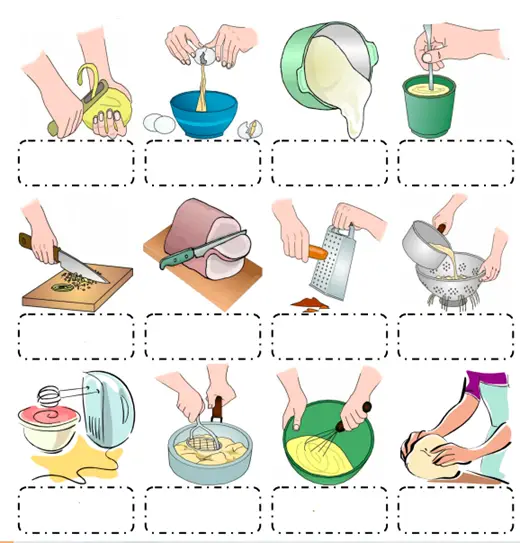
    A. Exercise: Vocabulary

    1. Write the correct verb in the empty box below the picture.
    1. Match the verbs (A-L)  with the correct nouns (1-12).
    2. mash                                       1. a bowl 
    3. chop                                        2. a knife             
    4. grate                                        3. a whisker
    5. stir                                           4. a grater
    6. rack                                         5. a cooking spoon
    7. knead                                      6. a kitchen counter          
    8. pour                                         7. a strainer
    9. whisk                                       8. a peeler
    10. mix                                          9. a cutting board
    11. drain                                        10. a ricer
    12. peel                                         11. a mixer
    13. slice                                         12. measuring cup

    B. Exercise: Multiple Choice Questions

    Listen and choose the correct letter.

    1.   To poach something means:

    1. to cook it in a pot
    2. to boil it
    3. to cook it in liquid

    2.   To make poached eggs, we need 2 fresh eggs, 1L water and:

    1. 1 L of vinegar
    2. a wooden cooking spoon
    3. 1 tbsp of white vinegar

    3.   We serve the poached eggs on:

    1. bread
    2. butter and bread
    3. toast

    4.  First you light the stove and then:

    1. you put a frying pan on the stove
    2. you fry the egg on the stove
    3. you put a pot on the stove


    5. The water is simmering when:

    1. it is boiling
    2. there are bubbles but it’s not very hot
    3. it is ready for boiling

    6. Use a spoon to:

    1. mix the water
    2. whisk the water
    3. stir the water

    7. When the toast is ready:

    1. spread some butter on it
    2. melt some butter on it
    3. put some butter on it

    8. Before you put the egg on the toast, you have to:

    1. mash it
    2. drain it
    3. stir it

    9. The yellow part of the egg is called:

    1. sunny
    2. egg yellow
    3. yolk

    10. This part of the egg should be:

    1. tasty
    2. runny
    3. funny

    C. Exercise: Scrambled Sentences

    Read the scrambled sentences, then put them in the correct order to complete a pancake recipe. Write the correct recipe on the lines below.

    1 Whisk the eggs, then add the milk, a bit of salt, and flour. Stir well.
    2 Ingredients: 2 eggs, 250 ml milk, 150 ml flour, a bit of oil, a pinch of salt.
    3 Use a spatula to fry the pancake on both sides.
    4 Crack the eggs in a bowl.
    5 Serve hot or cold with a topping on the side.
  • ESL Grammar Worksheet: Using Articles (Elementary-Intermediate) (PDF)

    ESL Grammar Worksheet: Using Articles (Elementary-Intermediate) (PDF)

    Title image for articles worksheet

    Free worksheet to practice the correct use of articles for ESL teachers and students. (Free download available here.)

    Articles Exercise: Fill the Gaps

    Directions: Fill in the blank with the appropriate article, a, an, or the, or leave the space blank if no article is needed.

    1. I want ____ apple from that basket.

    2. ____ church on the corner is progressive.

    3. Miss Lin speaks ____ Chinese.

    4. I borrowed ____ pencil from your pile of pencils and pens.

    5. One of the students said, “____ professor is late today.”

    6 Eli likes to play ____ volleyball.

    7. I bought ____ umbrella to go out in the rain.

    8. My daughter is learning to play ____ violin at her school.

    9. Please give me ____ cake that is on the counter.

    10. I lived on ____ Main Street when I first came to town.

    11. Albany is the capital of ____ New York State.

    12. My husband’s family speaks ____ Polish.

    13. ____ apple a day keeps the doctor away.

    14. ____ ink in my pen is red.

    15. Our neighbors have ____ cat and ____ dog.

    Articles Exercise: Writing

    Directions: Write the following paragraphs, inserting “a“, “an“, and “the“ where needed.

    1. I have horse of my own. I call her Pretty Girl. She is intelligent animal, but she is not thoroughbred horse. I could never enter her in race, even if I wanted to. But I do not want to. She is companion, for my own pleasure. I took her swimming day or two ago.

    2. Horse knows when he is going to race. How does he know? His breakfast was scanty. (He is angry about that.) He does not have saddle on his back. He is being led, not ridden, to grandstand. He is led under grandstand into unusual, special stall. Horse is nervous. Sometimes he does not know what to do when starting gate flies open and track is before him. If he does not begin to run instantly, other horses are already ahead of him.

    During race, when he sees another horse just ahead of him, he will try to pass him. Sometimes jockey holds him back to save his energy for last stretch. Eventually horse gets to run as fast as he can. Exercise boy, watching owner’s favorite jockey riding horse he has exercised day after day, says nothing. Secretly, he is planning for day when he will be jockey himself, and his horse will be first to cross finish line.

    3. Most people have fewer hours to give to time-consuming activities of clubs than they used to have, but most people in small town belong to club or two. One of clubs is likely to be social and benevolent organization, such as Rotary or Elks.

    Business people are likely to belong, also to either Kiwanis Club or Lions. Such business people’s organizations may meet as often as once a week in one of private dining rooms of town’s leading hotel for lunch. They have good lunch, hear good program, and continue their fundraising program for worthy organization, such as local hospital.

  • ESL Grammar Worksheet: -ed & -ing Adjectives: Describing Feelings & Situations (Elementary-Intermediate)

    ESL Grammar Worksheet: -ed & -ing Adjectives: Describing Feelings & Situations (Elementary-Intermediate)

    Title image for ed and ing ending adjectives

    Free worksheet to learn about adjectives end with “-ed” and “-ing” for ESL teachers and students. (Free download here)

    ‘My holiday was relaxing. I felt really relaxed.’

    Few, but common, adjectives end in either -ed or -ing:

    worried/worrying, interested/interesting, excited/exciting

    -ed Adjectives

    Adjectives that end in -ed are used to describe how people feel:
    ‘He was surprised to find that he had been upgraded to first class.’
    ‘I was confused by the findings of the report.’
    ‘She felt tired after working hard all day.’

    -ing Adjectives

    Adjectives that end in -ing are used to describe things and situations. Compare these example sentences to the ones above:
    ‘Being upgraded to first class is surprising.’
    The findings of this report are confusing.’
    ‘Working hard all day is tiring.’

    Example Table

    Feeling: “-ed“Description: “-ing”
    annoyedannoying
    boredboring
    confusedconfusing
    challengedchallenging
    depresseddepressing
    excitedexciting
    frustratedfrustrating
    frightenedfrightening
    satisfiedsatisfying
    shockedshocking
    Scaredscary

    Exercise one: Use the Correct Adjective

    Now complete the sentences below using the correct adjective

    Dogs often feel ___ during fireworks.

    frightening
    frightened

    The software program can be ___ the first time you use it.

    confusing
    confused

    Satoru was ___ to hear about the earthquake.

    shocked
    shocking

    • I think that rainy days in winter are ___.
    • depressing
    • depressed
    • She’s ___ of doing the same thing every day.
    • boring
    • bored
    • I was so___________ to go on vacation. 
    • exciting
    • excited
    • The meals at Cheesecake Factory  are ___. 
    • satisfied
    • satisfying

    Exercise two: Writing: My First Day Essay

    I want you to describe your first day doing something challenging. You could write about your first day in the United States, your first day at school, your first day at university or high school or your first day at a new job.

    How did you feel? Where you excited, frightened or bored?

  • ESL Writing Practice Worksheet: Newspaper Articles (Intermediate-Advanced)

    ESL Writing Practice Worksheet: Newspaper Articles (Intermediate-Advanced)

    Free worksheet to practice writing with newsletter articles for ESL teachers and students. (Free download available.)

    Introduction: Writing Newspaper Articles

    Students often read newspapers for a wide variety of reasons, not least of which is to keep informed in English. As you know, newspaper writing style tends to have three levels:

    • Headlines
    • leading phrases (intro, teaser)
    • article content

    Each of these has its own style. This lesson focuses on calling students’ attention to this type of writing style on a deeper, grammatical level. It ends with students writing up their own short articles, with a follow-up listening comprehension opportunity.

    Aim: Improved writing skills and understanding newspaper writing style
    Activity: Writing short newspaper articles
    Level: Intermediate to upper intermediate

    Article: FAKE VAN GOGH SELLS FOR $35 MILLION

    A fake painting supposedly by Vincent van Gogh has been sold for $35 million in Paris. (Paris, June 9, 2004)

    Imagine this: It’s the chance of a lifetime. You have the necessary cash, and you have the opportunity to buy a Van Gogh. After purchasing the painting and placing it on your living room wall to show to all your friends, you discover that the painting is a forgery!

    That’s what happened to an anonymous telephone bidder who purchased Sunflowers in the Wind at the Peinture Company in Paris, France. The first (supposed) Van Gogh painting to have been auctioned since last year’s record sale of $40 million, the forgery was sold for $35 million. The painting had also been reported to be the last ever offered for sale, Britain’s Daily Times reported Thursday.

    Unfortunately, shortly after the masterpiece had been transferred to the buyer’s home, the Academy of Fine Arts released a statement saying that Sunflowers in the Wind was a fake. Upon further investigation, the report proved to be true. The unlucky buyer was forced to recognize that he or she had indeed purchased a forgery.

    Exercise 1: Analyze the Article

    Use the provided example newspaper article, or take a newspaper into the class.

    Ask students to read the newspaper article and summarize the contents.

    Have students analyze the difference between the headline, leading sentence and article content in terms of tense usage and vocabulary in small groups (3-4 students).

    As a class, check that the differences between headline, leading sentence and article content are clear. Here is a short guideline to the main differences:

    • Headline: Simple tenses, idiomatic, flashy vocabulary, no use of function words
    • Leading sentence: Present perfect tense, often used to give general overview.
    • Article content: Proper tense usage, including a change from present perfect to past tenses to give detailed, specific information about what, where and when something happened.

    Exercise 2: Write Your Own Newspaper Article

    Have students split up into pairs or small groups (3-4 students).

    Small groups should write their own newspaper articles using the headlines provided or come up with their own stories. They should write the leading sentence and an at least three paragraphs long article.

    Headline 1: TRUCK CRASHES INTO LIVING ROOM

    Headline 2: LOCAL COUNCIL: ACTION NOT PROMISES

    Headline 3: LOCAL FOOTBALL PLAYER WINS BIG

    Have students read their newspaper articles aloud, allowing you to incorporate some listening comprehension into the lesson.

  • ESL Writing Practice Worksheet: Creating Concise Sentences (Intermediate-Advanced)

    ESL Writing Practice Worksheet: Creating Concise Sentences (Intermediate-Advanced)

    Writing Worksheet Creating Concise Sentences

    Free worksheet to practice writing for ESL teachers and students. (Free download available.)

    Descriptive Paragraphs

    Example: New York City

    New York City is in the United States.
    New York City is located in New York State.
    It borders on the Atlantic Ocean.
    It was founded in 1625 as “New Amsterdam”.
    It was first settled by the Dutch.
    It is important for commerce.
    Wall Street is located in New York City.
    It has many national and international banks.
    It has many important skyscrapers.
    The World Trade Center is located in New York City.
    The Empire State Building is in New York City.
    New York City is an important city for immigration.
    Ellis Island used to be the entry point for many immigrants at the turn of the century.
    There is an interesting immigration museum on Ellis Island. 

    New York, New York is located on the Atlantic Coast of the United States of America. It was first settled as “New Amsterdam” in 1625 by the Dutch. Today, New York City is an important commercial and banking center which includes Wall Street. Among its many important skyscrapers are the World Trade Center and The Empire State Building. One of the most interesting museums is on Ellis Island which served as the entry point for many immigrants who passed through New York City.

    Exercise 1: Elvis Presley

    Arrange the sentences about Elvis Presley into idea groups. 

    Write a paragraph about Elvis Presley using the idea groups to create concise sentences. 

    Elvis Presley was an American.
    He was a singer and actor.
    He was famous for rock-and-roll.
    He was born in Tupelo, Mississippi.
    He was born on January 8, 1935
    He started singing in church.
    He taught himself to play the guitar.
    He first became popular on the local touring circuit for country-and-western music.
    He sang romantic songs.
    He danced erotically.
    Teens loved him for his new style.
    He had many hits.
    He sang “Love Me Tender”, “All Shook Up”, and “Don’t Be Cruel”.
    He died on August 16, 1977.
    He died in Memphis, Tennessee.
    He might have died of drug and alcohol abuse.

    Exercise 2: Creative Writing

    Choose a famous place or person. 

    Write several important facts about that place or person. 

    Arrange the sentences into idea groups. 

    Write a paragraph using the idea groups to create concise sentences.