Tag: no-author

  • 41 Artificial Intelligence Discussion Questions: Personal, Legal and Ethical

    41 Artificial Intelligence Discussion Questions: Personal, Legal and Ethical

    Artificial intelligence (AI) is one of the most exciting topics of our time. Intelligent, adaptive machines and robots can support us humans, make life easier and solve complicated problems.

    On the other hand, AI scares many people. Every technology also harbors risks, and it is not yet possible to foresee how our world will change once artificial intelligences are “really intelligent.”

    The topic therefore offers plenty of material for discussion: for a school or study project, or for a controversial conversation lesson for language students.

    In this article, we listed 41 interesting, personal, legal and ethical questions about artificial intelligence, to foster debates.

    Artificial intelligence: ESL questions, conversation starters

    Personal questions about artificial intelligence, for discussion

    This set of questions will help to start conversations about the various personal perspectives on AI.

    What are the risks of artificial intelligence?

    What are the opportunities of artificial intelligence?

    Can AI be more intelligent than humans?

    What excites you about AI?

    Can robots one day replace humans? In what areas?

    What jobs would you rather have robots do instead of humans?

    In what tasks will humans always be better than robots?

    Could you imagine being friends with a human-looking robot?

    How might AI solve humanity’s problems?

    Should we be afraid of an AI taking power over us one day?

    Can an AI be truly objective, even though it was developed by humans?

    Can an AI develop feelings?

    Can an AI have compassion or a sense of justice?

    Will humans become smarter or dumber by using AI? Why?

    What are the advantages and disadvantages of letting AIs make decisions for us?

    Which movie about AI do you like best, and why?

    Questions about the use of artificial intelligence in everyday life

    Today, AI has already spread into each area of our daily life. With these questions, you can exchange opinions on this development.

    Where does artificial intelligence already support you in your daily life?

    In which areas should AI be used more intense?

    What scenarios do you know for the use of AI in business?

    Would you ride in an autonomous driving car? Or in an autonomous flying machine?

    What would you use a robot for?

    Would you rather have services – like haircuts – provided by robots than humans if it cost less?

    Do you use voice assistants like Siri or Alexa? Why, or why not?

    Have you had a conversation with a chatbot when you were at a company’s customer service desk? What was your experience?

    How has the use of AI already changed your profession? How will your profession change in the coming years?

    What apps from your smartphone are already using AI?

    What things would you like to do yourself, although an AI might be better at it?

    Which “smart” device would you like to have at home, and which not?

    Legal and ethical questions about artificial intelligenc

    These questions are for advanced students and can be used to start highly controversial and even philosophic discussions.

    What is artificial intelligence anyway? At what point is a machine truly intelligent?

    How might an AI be taught to respect human rights?

    Is an AI allowed to make decisions on its own that can greatly affect people’s lives?

    Do there need to be laws governing what an AI can and cannot do?

    If robots can think for themselves, don’t you need to be given personal rights?

    If an AI injures or kills a human, who is to blame? The manufacturer, the owner, or the AI itself?

    Do AIs need liability insurance?

    Who owns all the data an AI collects or generates itself?

    When AIs always and anywhere collect data about all aspects of our lives: how do data privacy laws need to change?

    Should weapons systems be equipped with AI for war? Why or why not?

    How can we prevent AIs from developing the same prejudices as humans, for example against women, people of color, or ethnic minorities?

    Should AIs be able to stop humans from doing bad things?

    Tips on Using AI Questions in the Classroom

    You can put students into pairs or small teams, or discuss the questions with the entire class. Another option is to ask your students individually to write down short answers or longer essays on a specific questions. Later, they can present their thoughts in front of the class.

    By using these questions, your students will learn new vocabulary in the context of artificial intelligence. They will learn how to analyze complex topics, consider different viewpoints, which helps them in daily life and especially in business. 

    These questions can be perfectly combined with other ESL Technology Questions. Another great option to start conversations are “Would You Rather” Questions or these fun speaking activities.
    You can find all of our teaching resources here.

  • 61 ESL Technology Questions for Exciting Conversations (PDF)

    61 ESL Technology Questions for Exciting Conversations (PDF)

    Struggling to find good ESL questions to do a class about technology?

    Now no longer! We’ve compiled a list of questions for you and your students to practice speaking, writing and exchanging ideas — no matter what age or level they are!

    With technology reaching every part of our lives, it is getting increasingly important to prepare your students to get used to the topic.

    51+ Technology ESL Questions  for your lessons

    Tips on Using Technology Questions in the Classroom

    You can put students into pairs or small teams, or discuss the questions in class. Another option is to ask your students individually to write down some phrases. Later they can present their results in class.

    By using these questions, your students will learn new vocabulary in the context of technology. This will help them in daily lives and especially in business. 

    General Technology Questions

    This set of questions will help your students to get a brief overview over the topic “technology”.

    • What is technology?
    • What do you think of when you hear the word ‘technology’?
    • How has technology changed in the past?
    • How has technology changed your life?
    • Could you live without technology?
    • What technological achievement was the best?
    • What do you think technology will be like in the future?
    • What are the advantages of technology?
    • What are the disadvantages of technology?
    • Which new technological tool are you looking forward to?
    • What do you think will be the next biggest technological advance?

    Opinion and Discussion Technology Questions

    Your students can exchange opinions and ideas using these questions. It’s also perfect to start a conversation.

    • At what age should children get a cell phone?
    • How many hours a day should children be allowed to use electric devices?
    • What are the disadvantages of using technology?
    • Do you think people rely too much on technology?
    • What do you think about online shopping?
    • Does technology make society lazy?
    • Do you prefer Windows or Apple computers?
    • Do you prefer to text your friends or call them?
    • What do you think of today’s technology? Do we use it the right way?
    • Do you think that technology controls and spies on us?
    • How can countries help to create more inventors?
    • Is there a piece of technology that you are afraid of that might exist in the future? (artificial intelligence, flying cars)
    • Which technology has made the world worse?
    • What are the possibilities of technology in clothing?
    • What is the future of transportation?
    • What do you think old people think of modern technology?
    • How has technology changed society?
    • Do you think modern technology reduces or increases stress? Why?
    • Do you think robots will cause unemployment in the future? Why? Why not?
    • What do you think about GMO (genetically modified organisms) food?
    • What changes would you like to see science make to the world?

    Personal Technology Questions

    These questions will give students the possibility to talk or write about their personal background of using technology.

    • At what age did you have your first cell phone? Which one was it? What did you like about it?
    • What is the most important technology device in your daily life?
    • How often do you use a cell phone?
    • Do you think you are addicted to technology, like social media or your cell phone?
    • Which social networks do you use? Why?
    • Are you shopping online? Why and how often?
    • What device do you use to watch TV, Netflix or other TV shows?
    • How much time do you spend online every day?
    • How often do you play video games?
    • Do you usually buy apps in GoogleStore or AppStore?
    • What is your favorite website?
    • Do you stream music? Why? Why not?
    • Do you use a smartwatch? Why? Why not? 
    • What moment do you remember, when you were let down by technology?
    • Are you afraid of technology in the future?
    • Are you giving out lots of personal data?
    • What do you know about Artificial Intelligence (AI)?
    • Have you used the Internet to learn English?
    • How have technological advances affected our life?
    • What science fiction movies have you seen? Which ones did you like? Why?

    Controversial Questions about Technology in the Future

    • Will advancements in artificial intelligence lead to a loss of jobs for humans?
    • Should governments regulate the development and use of autonomous weapons?
    • Will virtual reality become a primary form of entertainment and communication in the future?
    • Should there be limits placed on the use of facial recognition technology by law enforcement?
    • Will the increasing use of technology lead to a loss of privacy for individuals?
    • Should there be limits on the use of genetic engineering to modify human embryos?
    • Will the widespread use of drones have a negative impact on personal privacy and security?
    • Should companies that collect large amounts of personal data be required to provide greater transparency about how that data is used?
    • Will the increasing dependence on technology lead to a loss of critical thinking skills in individuals?
    • Will the increasing use of automation in various industries lead to a widening income gap and increased social inequality?

    These questions are perfect to include into your conversation lessons. You can go in detail by using our Artificial Intelligence Questions. Another great option to start conversations are “Would You Rather” Questions or these fun speaking activities.
  • School & Classroom Objects – ESL Vocabulary Worksheets & Flashcards

    School & Classroom Objects – ESL Vocabulary Worksheets & Flashcards

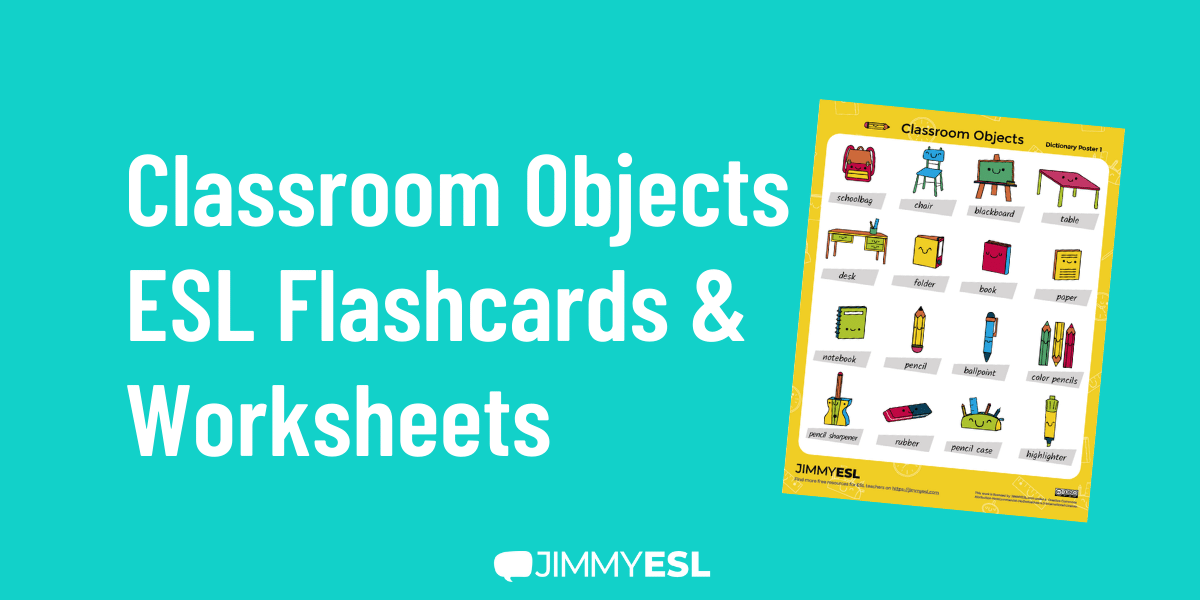
    Teach English vocabulary related to school objects or classroom objects to your students – with our lovely illustrated ESL worksheets and flashcards, exclusively from JIMMYESL.

    Kids – and likely adults, too – will love the “smiling items” and thus will be highly motivated to learn the new vocabulary and to complete the exercises in the worksheets.

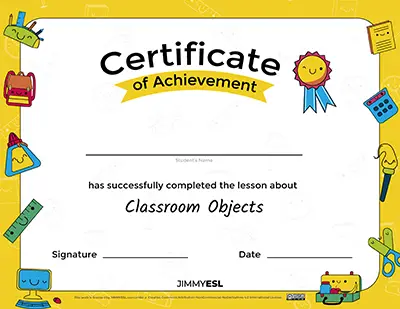
    Reward your students with a personal Certification of Achievement after taking the lesson!

    Please leave a comment below if you like it!

    Classroom objects flashcards and worksheets for ESL lessons

    License Info

    Worksheets: Use them for your lessons and share them with your fellow teachers. Details: Creative Commons Attribution-NonCommercial-NoDerivatives 4.0 International License

    Stand-alone Illustrations: All rights reserved. Please contact us if you want to use them.

    Free Worksheets Package

    The free, downloadable and printable worksheet package includes the following resources:

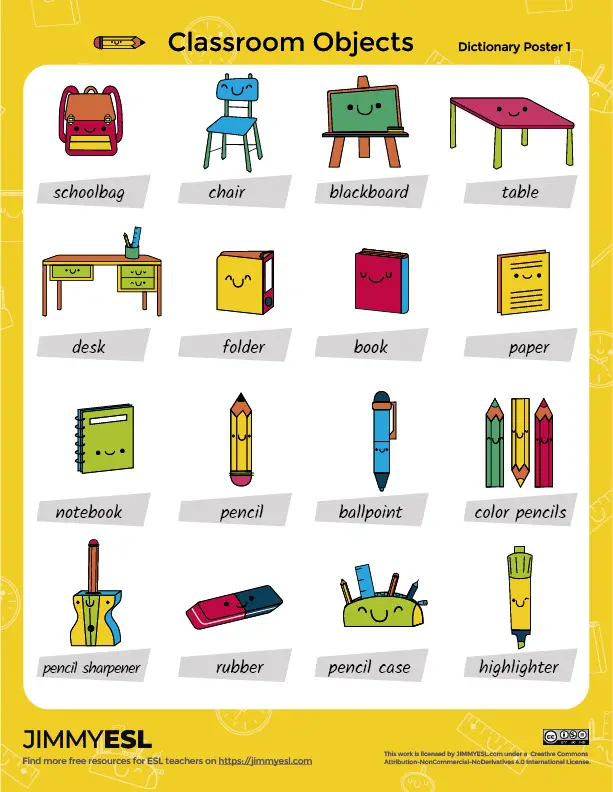
    • Dictionary Poster
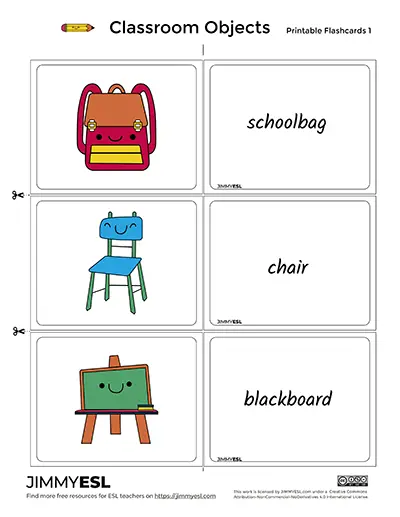
    • 32 Flashcards
    • Worksheet “Missing Letters”
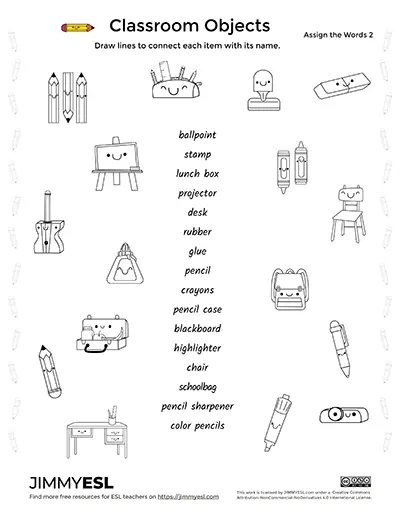
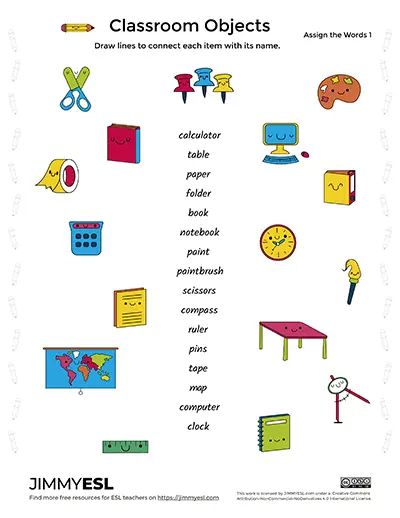
    • Worksheet “Assign the Items”
    • Certificate of Achievement

    Things Found in the Classroom

    The free worksheets include the vocabulary for these 32 classroom objects:

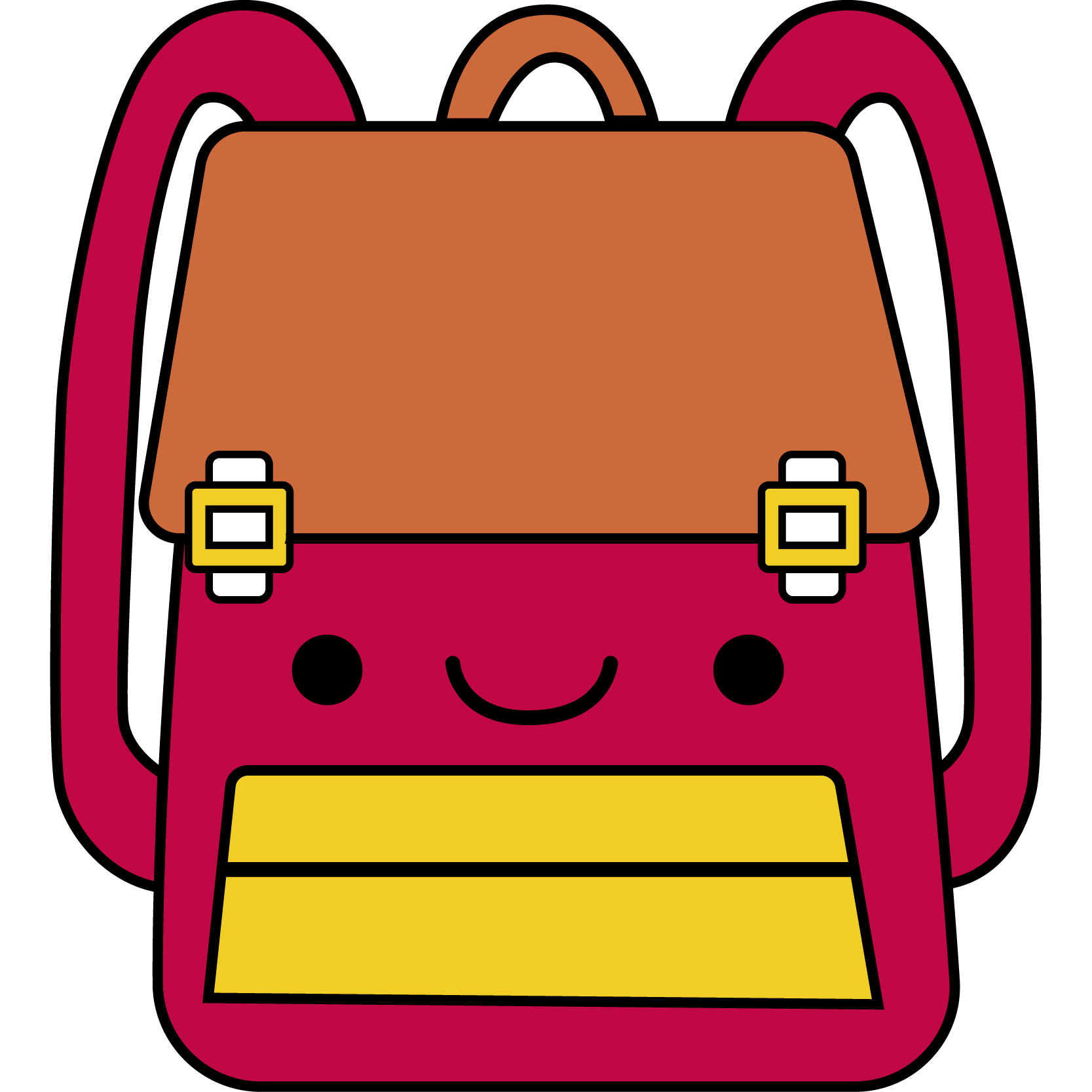
    schoolbag

    I pack my schoolbag in the morning.

    chair

    I sit on a chair.

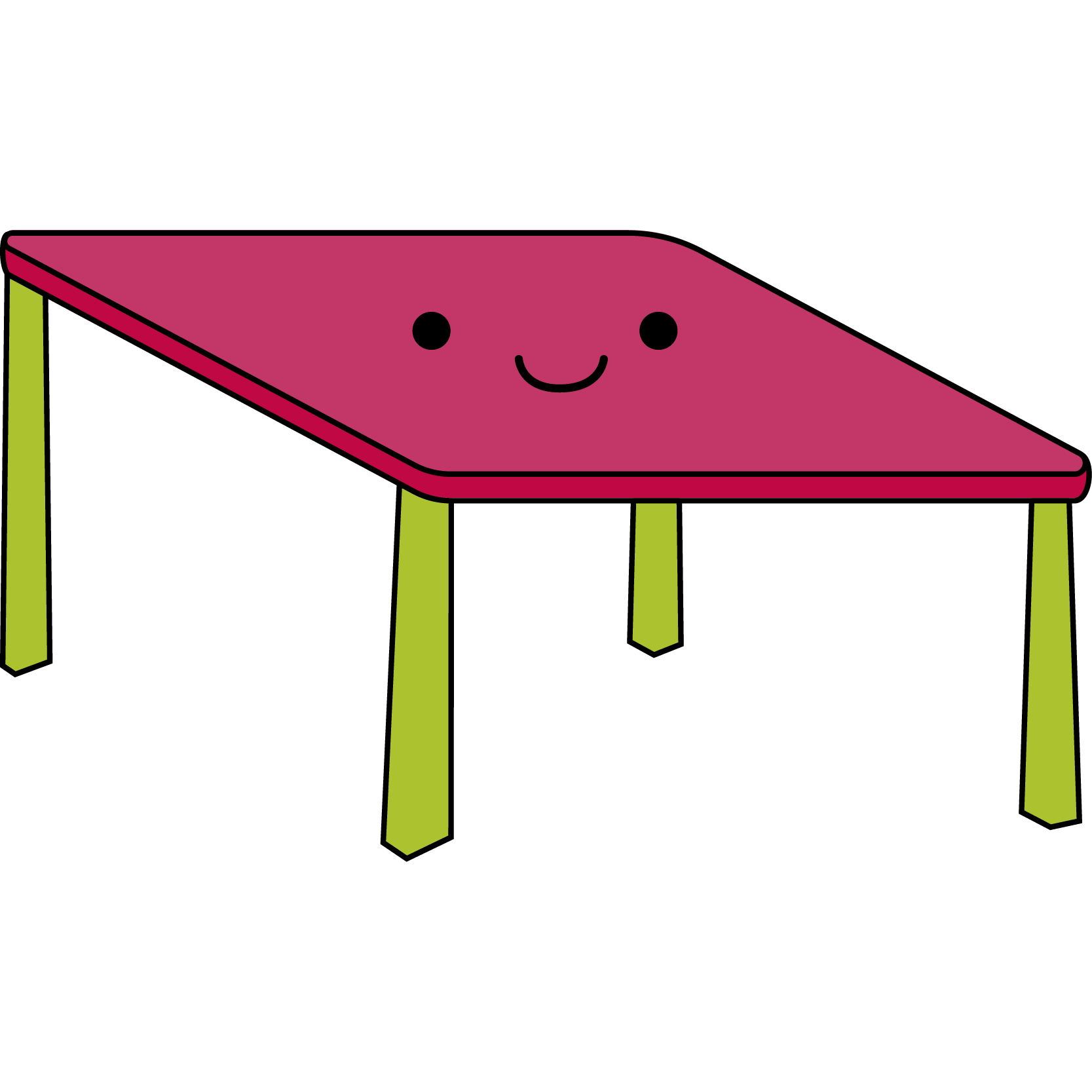
    table

    I work at the table.

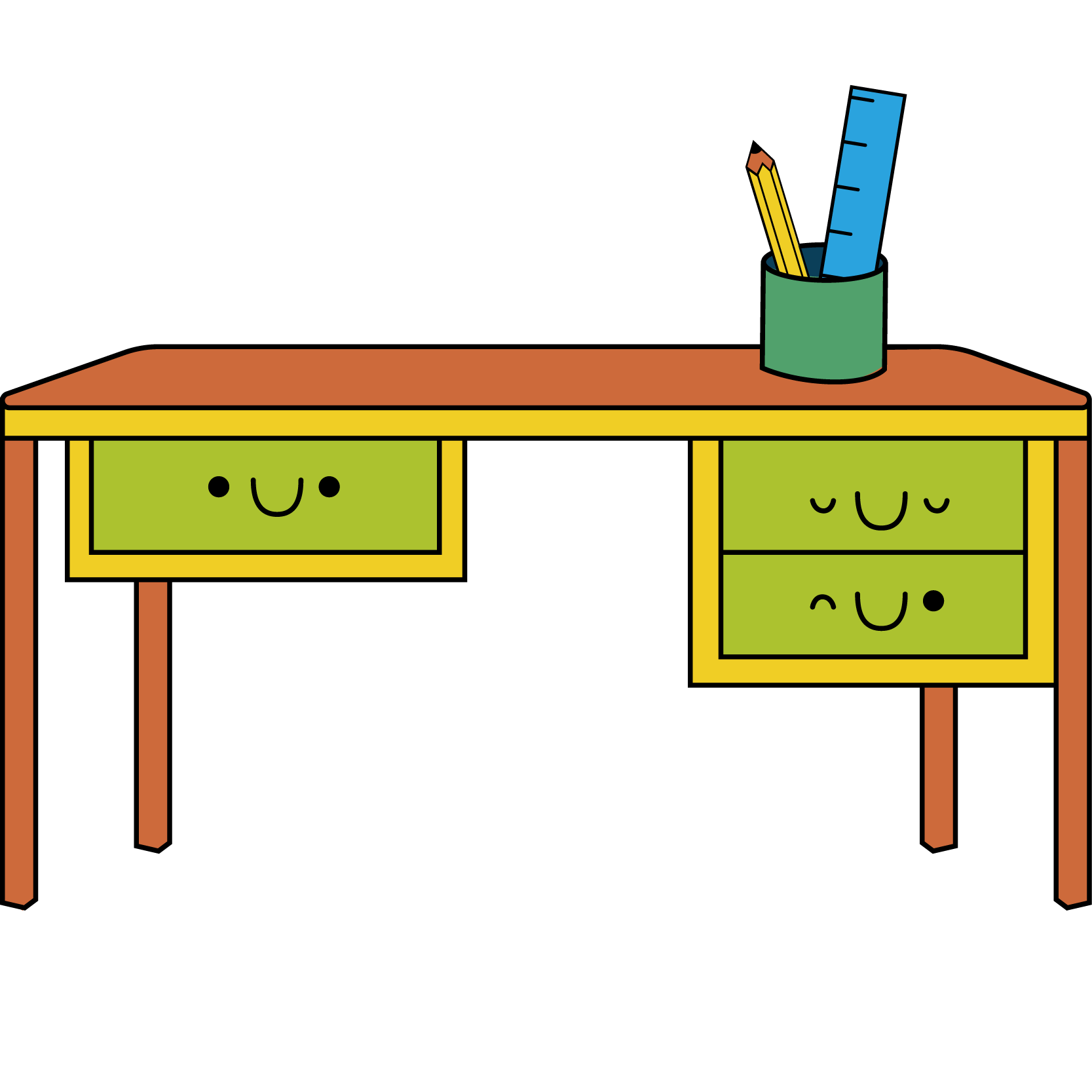
    desk

    The teacher sits at the desk.

    blackboard

    The questions are on the blackboard.

    book

    I read my book.

    folder

    I keep my work in my folder.

    notebook

    I take notes in my notebook.

    paper

    I write on the paper.

    pencil

    I use my pencil to write.

    pencil case

    I keep my stationery in my pencil case.

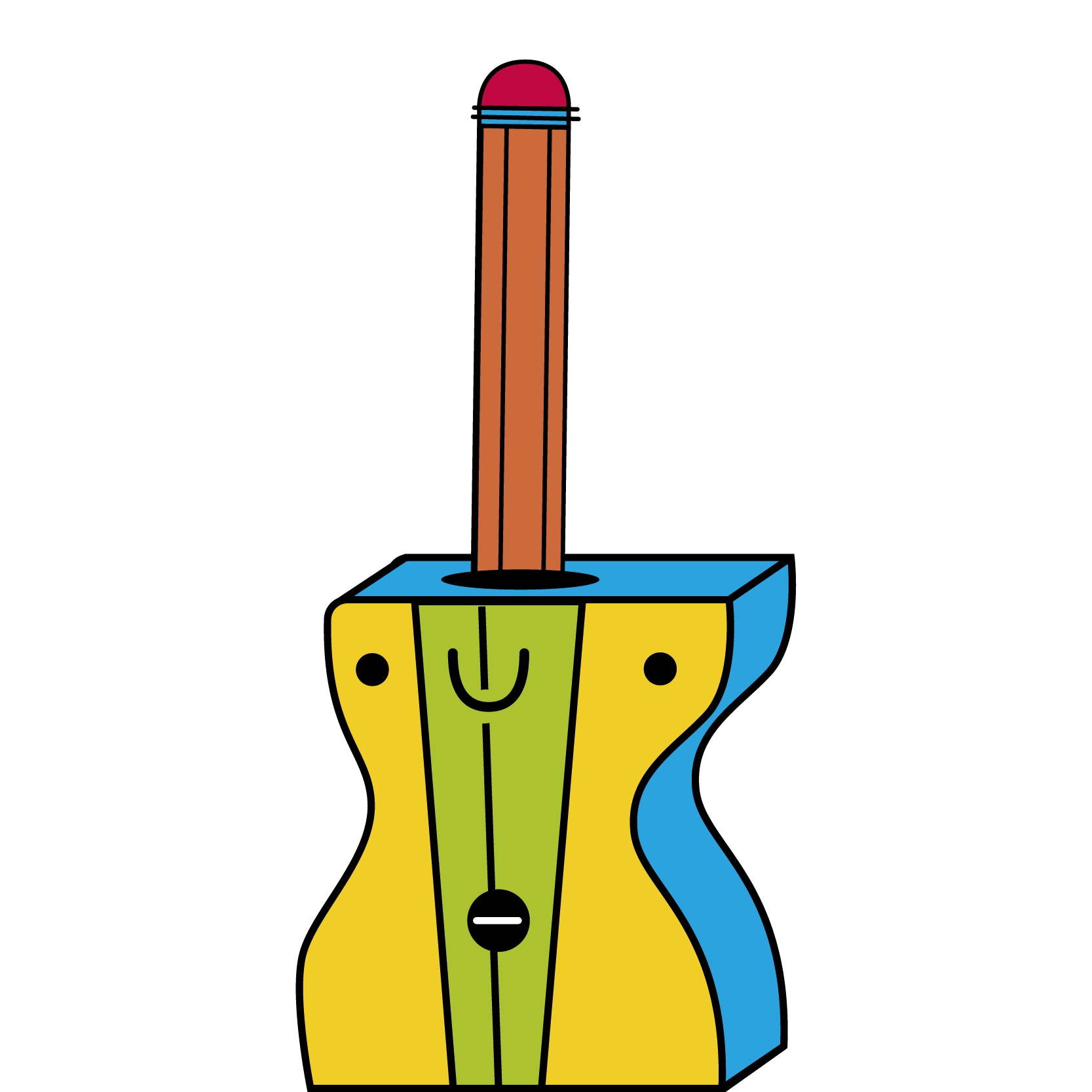
    pencil sharpener

    I use a pencil sharpener when my pencil is blunt.

    rubber

    I use a rubber when I make a mistake.

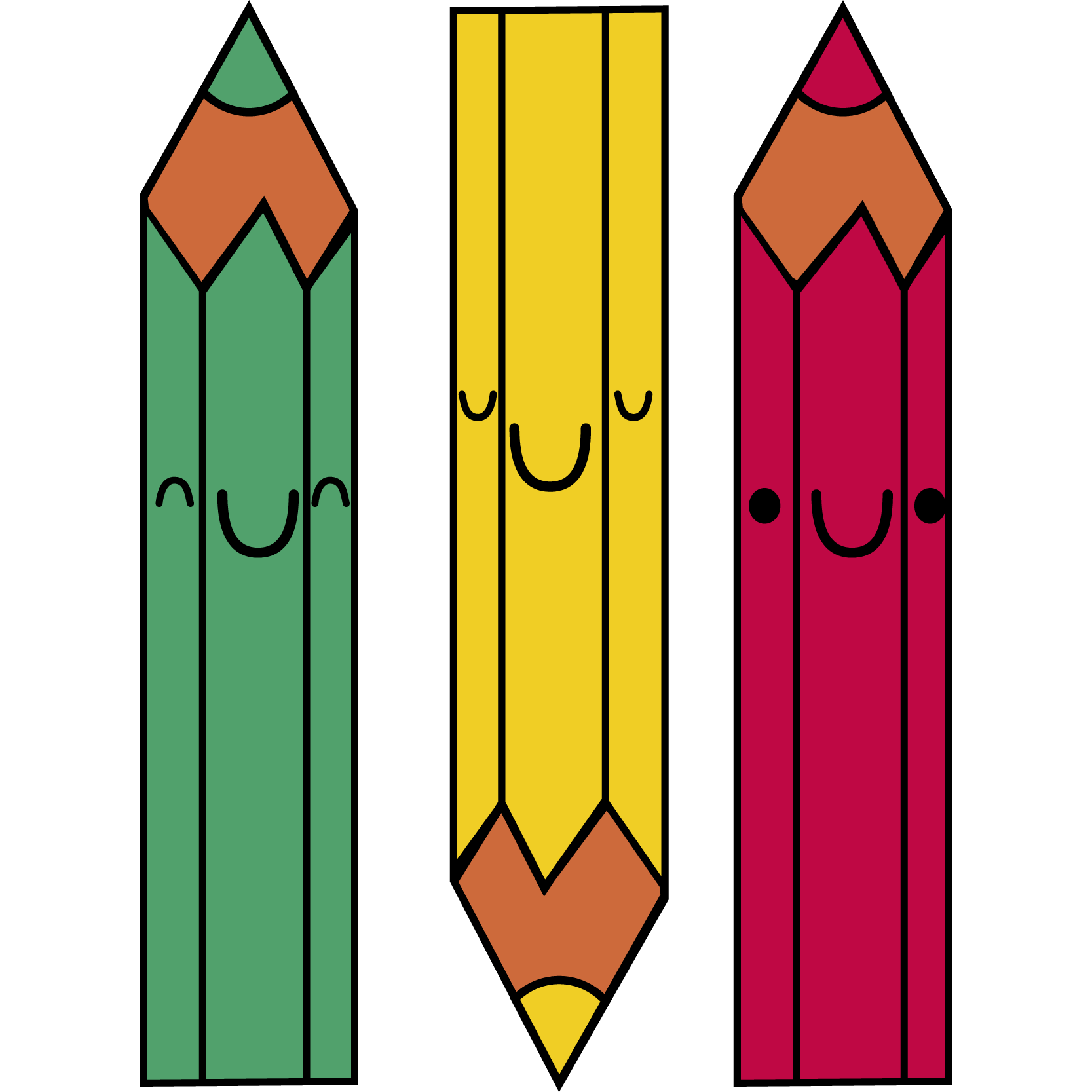
    color pencils

    It’s fun to use color pencils.

    ballpoint pen

    I sometimes write with a ballpoint pen.

    highlighter

    A highlighter makes it easy to find parts of a sentence.

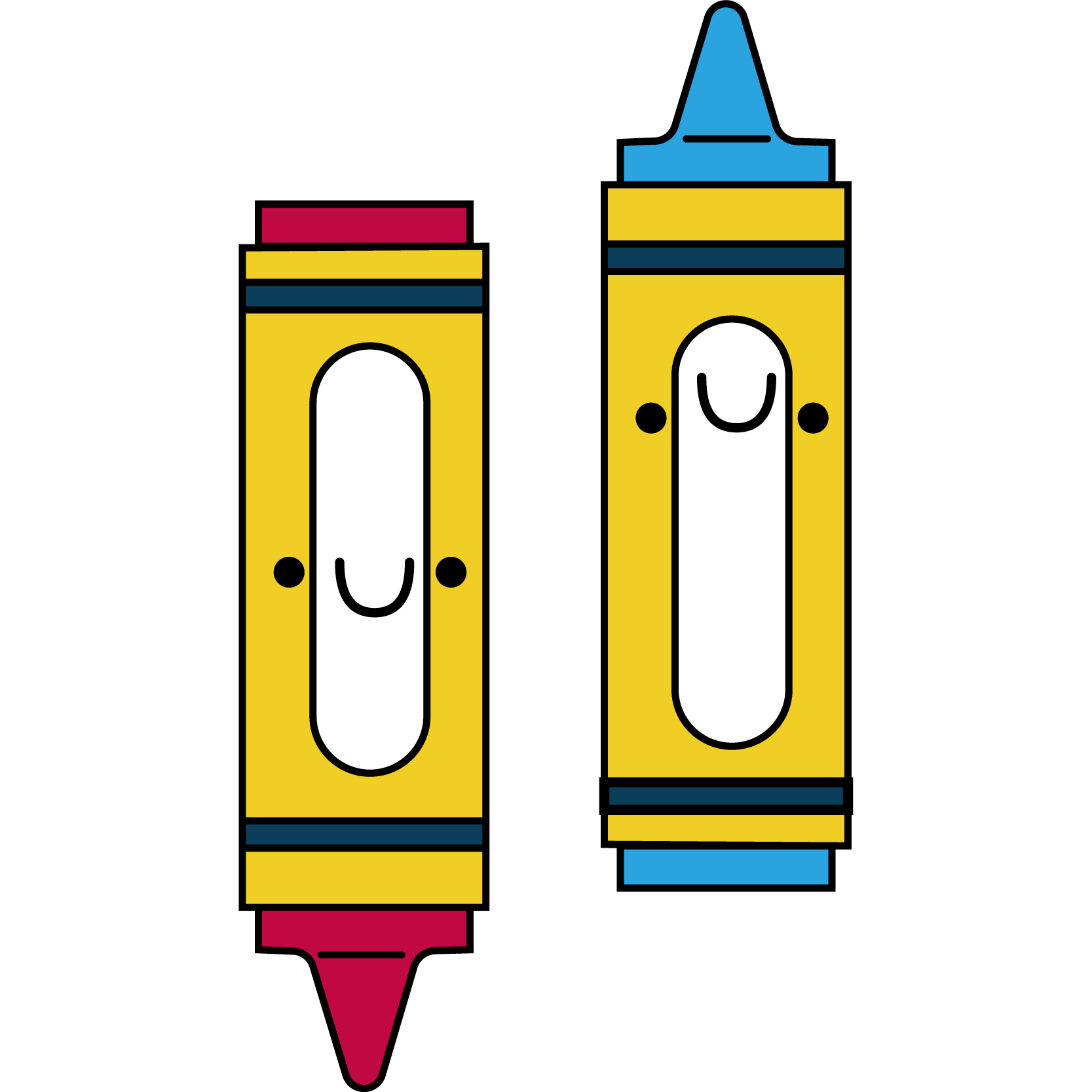
    crayons

    I use crayons to color my pictures.
    paint

    Paint can be fun but very messy!

    paintbrush

    I use a paintbrush to paint.

    scissors

    Scissors help me cut things.
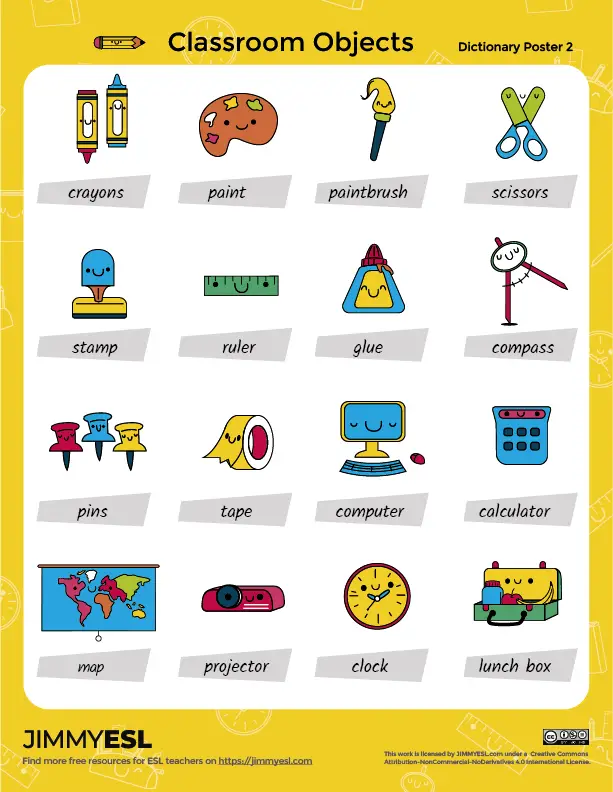
    stamp

    The teacher stamps my work when it is finished.
    ruler

    A ruler tells me how long things are.

    glue

    Glue helps me stick things together.

    compass

    A compass makes it easy to draw a circle.

    pins

    We use pins to stick things to the board.

    tape

    Tape can also be used to stick things together.

    computer

    I use the computer to search the internet.

    calculator

    A calculator makes it easier to add big numbers.

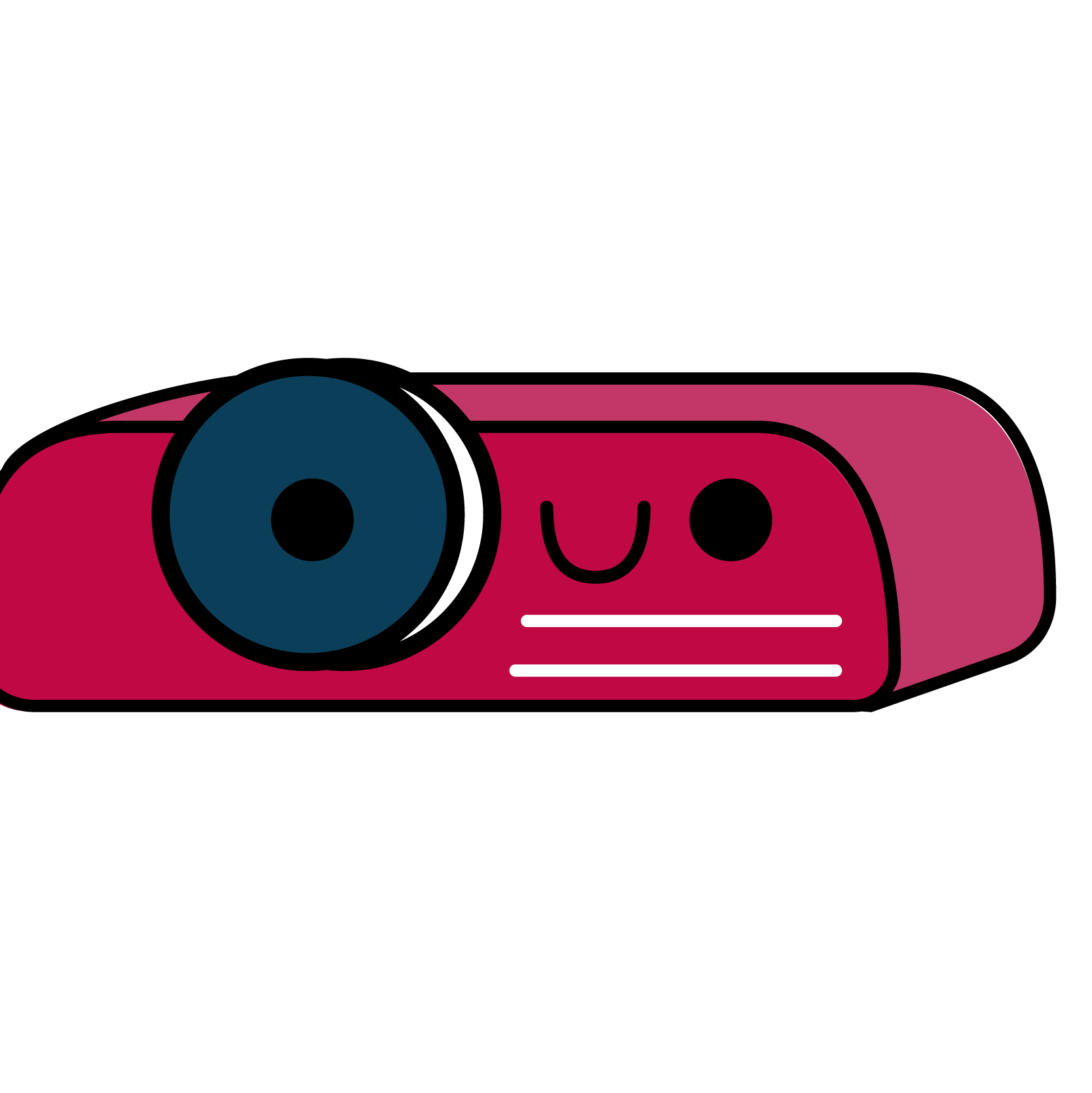
    projector

    We can see big pictures using the projector.

    map

    A map shows different places.
    clock

    I use a clock to tell the time.

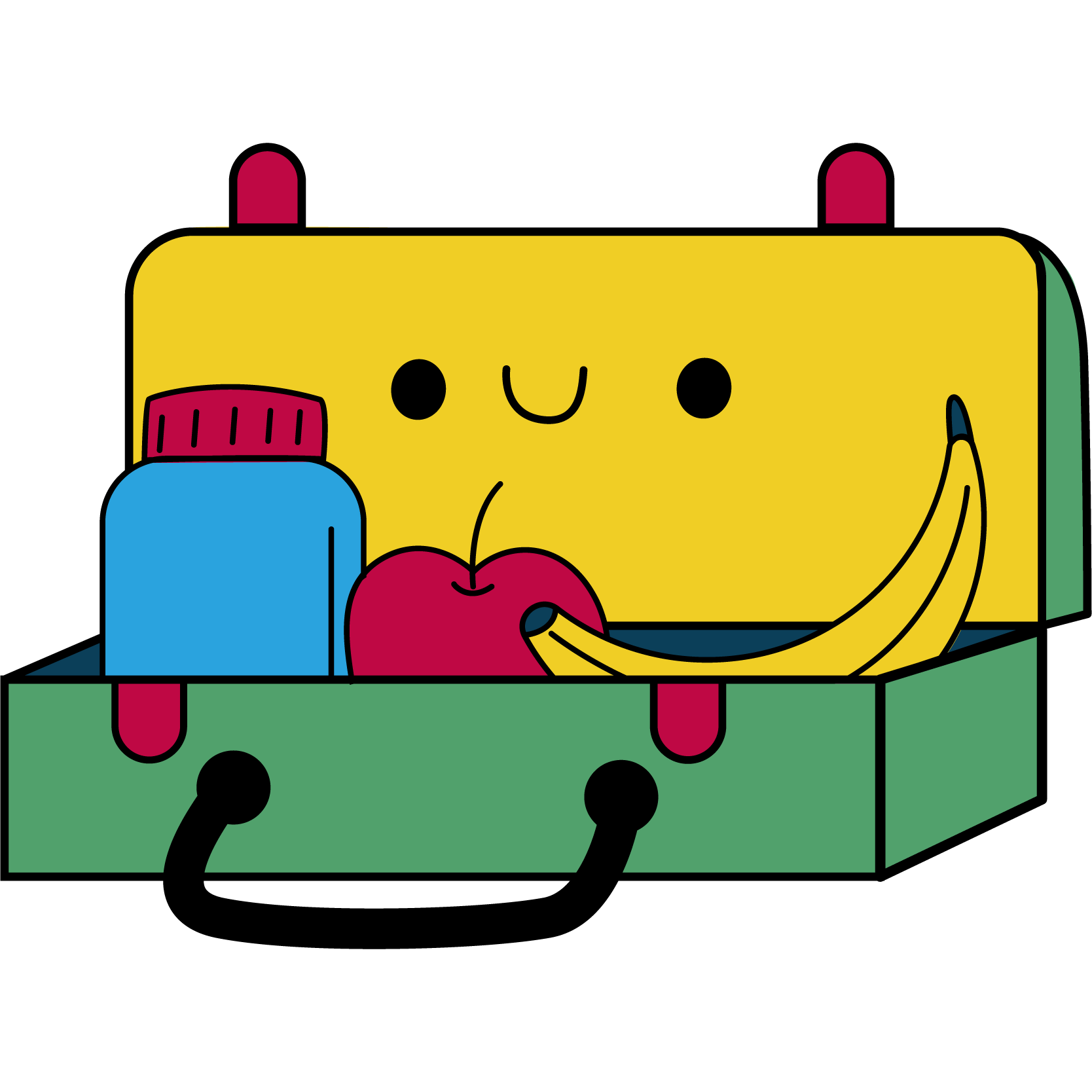
    lunchbox

    All of my tasty food is in my lunchbox.

    Classroom Objects: The Worksheets

    Dictionary Poster

    The Dictionary Poster lists all 32 school and classroom objects. Print it and attach it to your classroom wall! – 2 pages

    Poster Page 1
    Poster Page 2

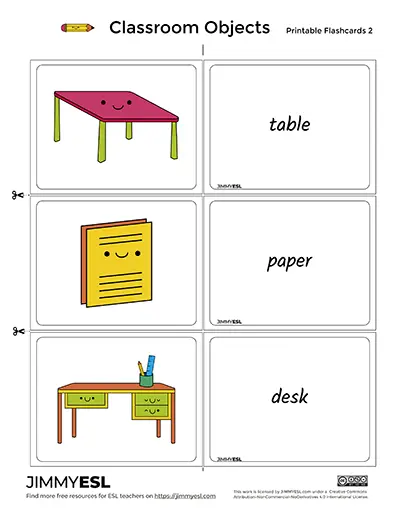
    Printable Flashcards

    Teach school & classroom objects vocabulary with flashcards. – 32 flashcards

    Printable Flashcards Page 1
    Printable Flashcards Page 2

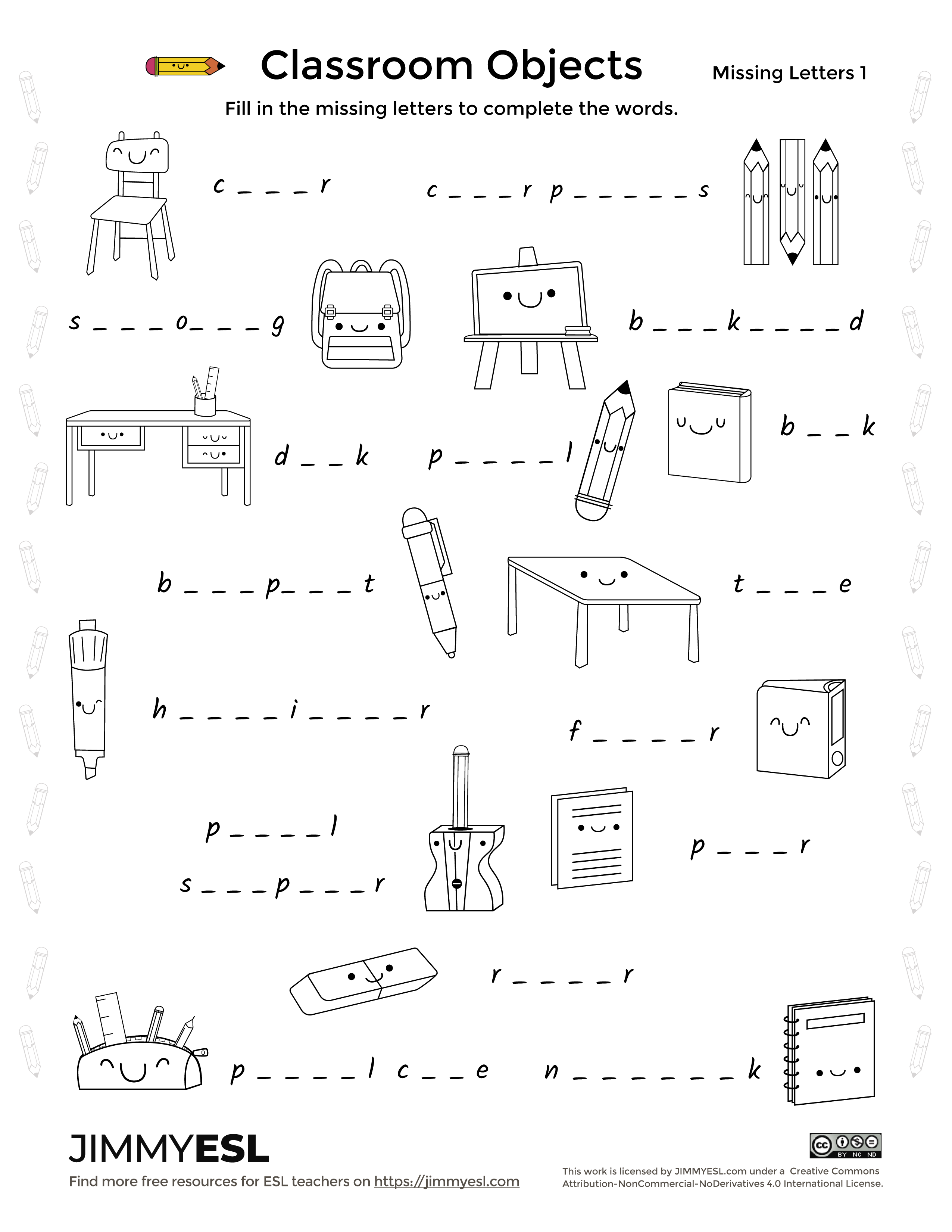
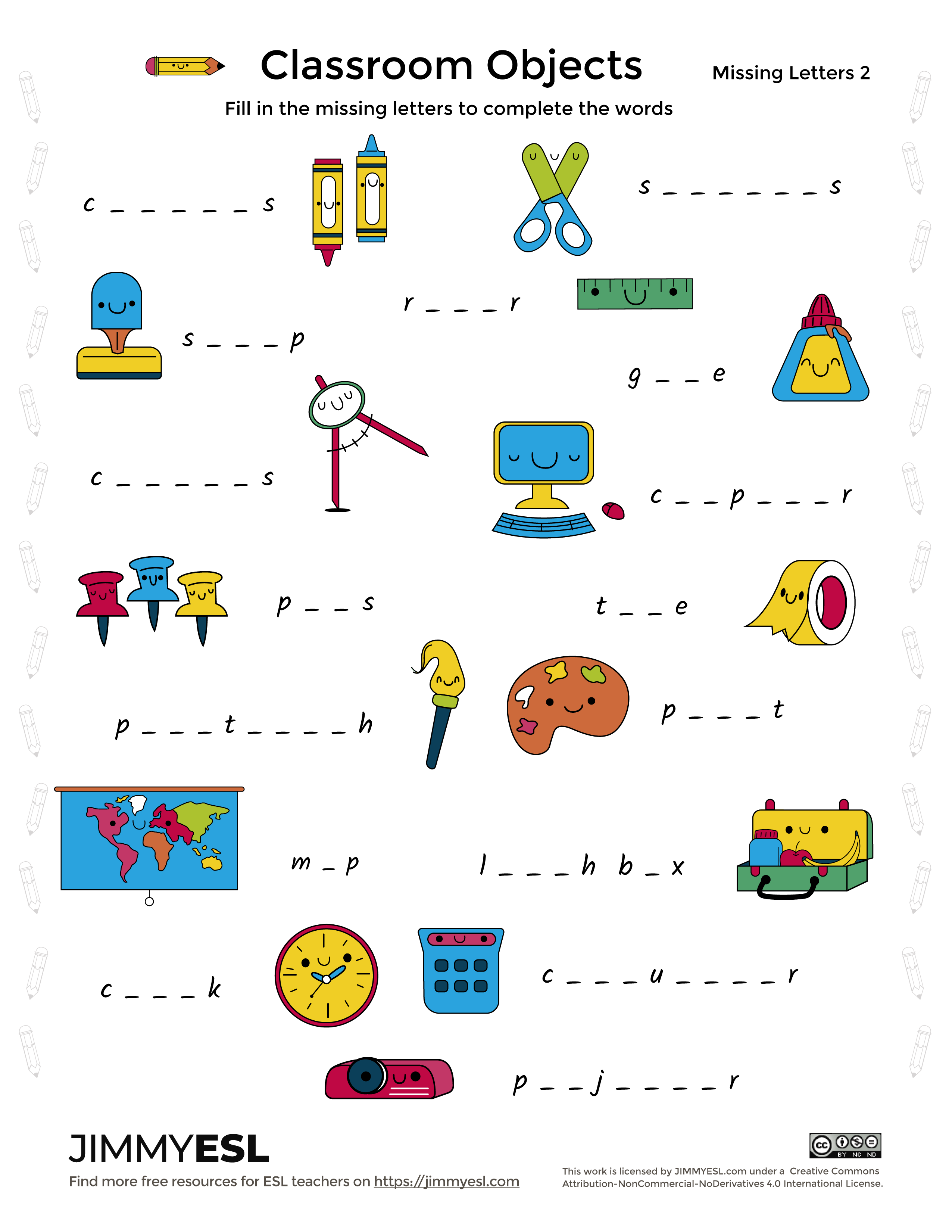
    Worksheet: Missing Letters

    Let your students fill in the missing letters to complete the item names and color in the illustrations. – 2 pages, colored and black & white to color in

    Black & White Worksheet Page 1
    Colored Worksheet Page 2

    Worksheet: Assign the Items

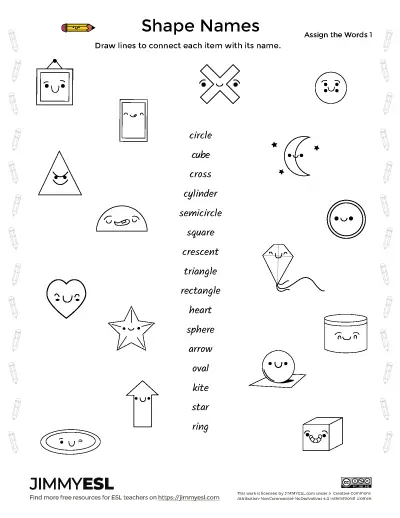
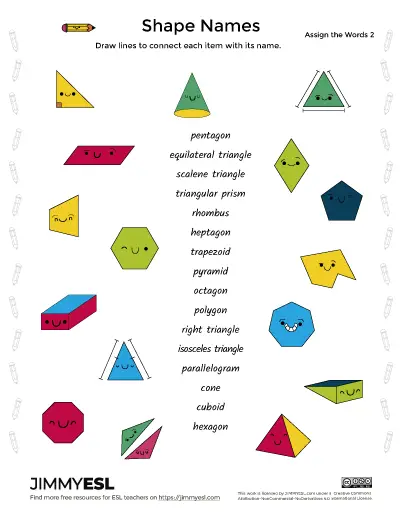
    Let your students assign the items to their names by drawing lines. – – 2 pages, colored and black & white to color in

    Black & White Worksheet Page 1
    Colored Worksheet Page 2

    Certification of Achievement

    Reward your students for their effort with a personal printable certification. – 1 page

    Certificate

    Also available:

  • Shape Names – ESL Vocabulary Worksheets & Flashcards

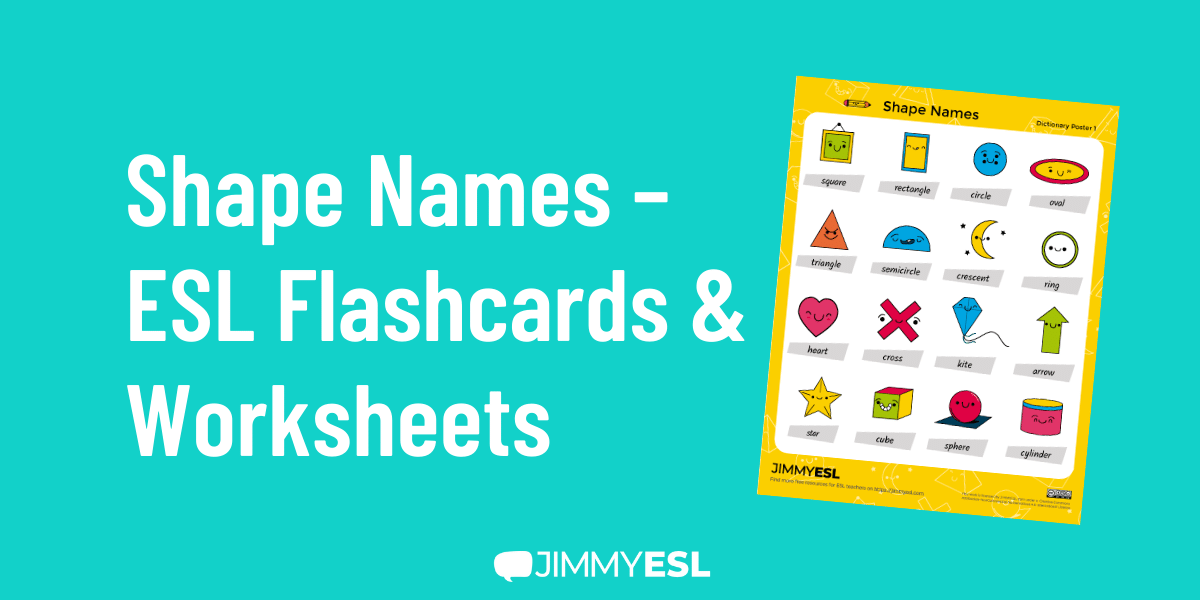
    Shape Names – ESL Vocabulary Worksheets & Flashcards

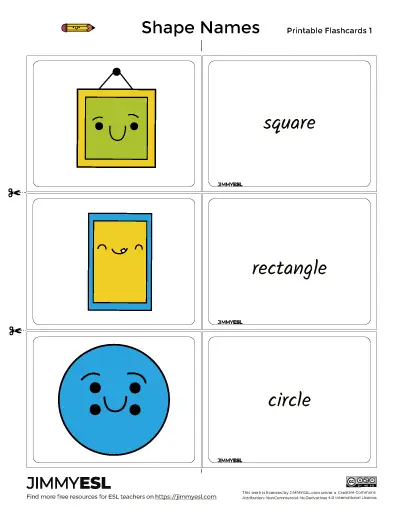
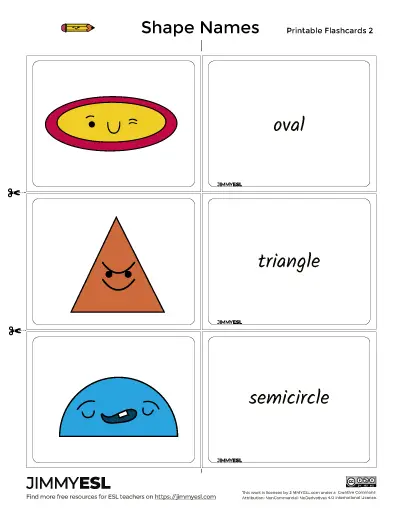
    Teach the most common shape names to your learners – with our lovely illustrated ESL worksheets and flashcards, exclusively from JIMMYESL.

    Kids – and likely adults, too – will love the “smiling shapes” and thus will be highly motivated to learn the new vocabulary and to complete the exercises in the worksheets.

    Reward your students with a personal Certification of Achievement after taking the lesson!

    Please leave a comment below if you like it!

    Shape Names Flashcards and Worksheets

    License Info

    Worksheets: Use them for your lessons and share them with your fellow teachers. Details: Creative Commons Attribution-NonCommercial-NoDerivatives 4.0 International License

    Illustrations: All rights reserved. Please contact us if you want to use them.

    Free Worksheets Package

    The free, downloadable and printable worksheet package includes the following resources:

    • Dictionary Poster
    • 32 Flashcards
    • Worksheet “Missing Letters”
    • Worksheet “Assign the Items”
    • Certificate of Achievement

    Scroll down to get a detailed list of the included resources.

    Common Shape Names: The Items List

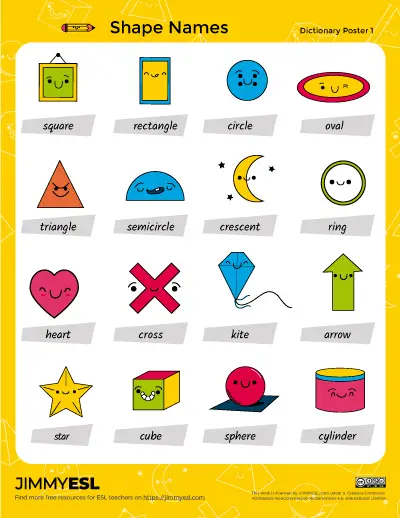
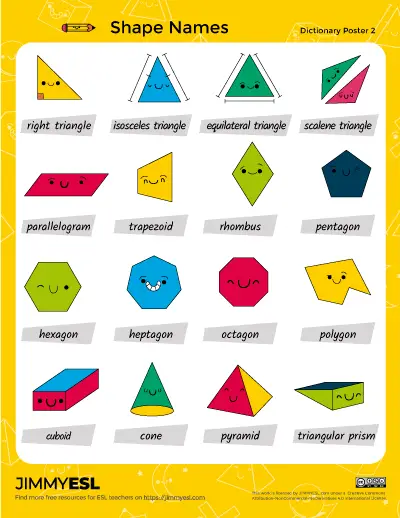
    The free worksheets include the vocabulary for these 32 shapes:

    square

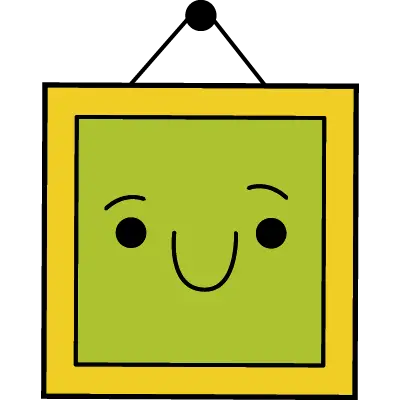
    This picture frame is a square.

    rectangle

    My TV is a rectangle.

    circle

    The clock is a circle.

    oval

    The rug is an oval.

    triangle

    Tortilla chips are triangles.

    semicircle

    I use a semicircle ruler in maths class.

    crescent

    The moon is a crescent.

    ring

    Rings are… ring shaped!

    heart

    A heart is the shape of love.

    cross

    A cross means no.

    kite

    I like to fly kites.

    arrow

    Arrows show us the way.

    star

    Stars are bright.

    cube

    Boxes are cubes.

    sphere

    Apples are spheres.

    cylinder

    Pipes are cylinders.

    right triangle

    A right triangle has a 90 degree angle.

    isosceles triangle

    An isosceles triangle has 2 equal sides.

    equilateral triangle

    An equilateral triangle has 3 equal sides.

    scalene triangle

    A scalene triangle has all 3 sides at different lengths.

    parallelogram

    My eraser is a parallelogram.

    trapezoid

    Gold blocks have a trapezoid shape.

    rhombus

    Rhombuses look like diamonds.

    pentagon

    The pentagon is an important building in the USA.

    hexagon

    Honeycombs are hexagons.

    heptagon

    Heptagons have 7 sides.

    octagon

    Stop signs are octagons.

    polygon

    A polygon can have many sides of different sizes.

    brick

    Bricks are used to make houses.

    cone

    Cones are great to put ice-cream in!

    pyramid

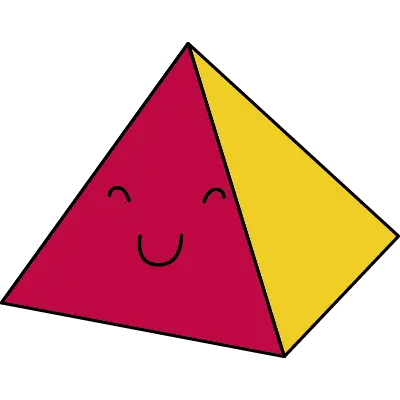
    The Egyptians built pyramids a long time ago.

    triangular prism

    A wedge of cheese is a triangular prism.

    Shape Names: The Worksheets

    Dictionary Poster

    The Dictionary Poster lists all 32 names of the shapes. Print it and attach it to your classroom wall! – 2 pages

    Poster Page 1
    Poster Page 2

    Printable Flashcards

    Teach the shape names vocabulary with flashcards. – 32 flashcards

    Printable Flashcards Page 1
    Printable Flashcards Page 2

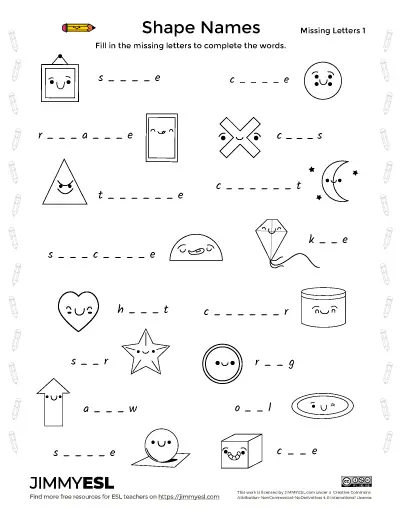
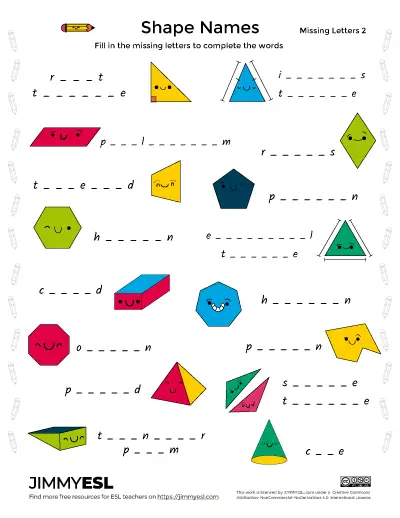
    Worksheet: Missing Letters

    Let your students fill in the missing letters to complete the shape names and color in the illustrations. – 2 pages, colored and black & white to color in

    Black & White Worksheet Page 1
    Colored Worksheet Page 2

    Worksheet: Assign the Items

    Let your students assign the shapes to their names by drawing lines. – – 2 pages, colored and black & white to color in

    Black & White Worksheet Page 1
    Colored Worksheet Page 2

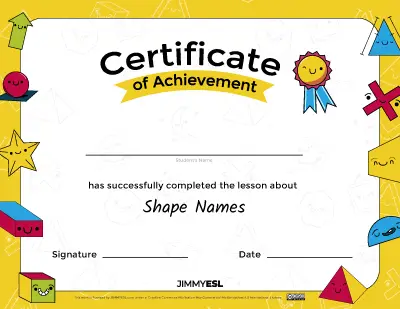
    Certification of Achievement

    Reward your students for their effort with a personal printable certification. – 1 page

    Certificate

    Also available:

  • Body Parts – ESL Vocabulary Worksheets & Flashcards

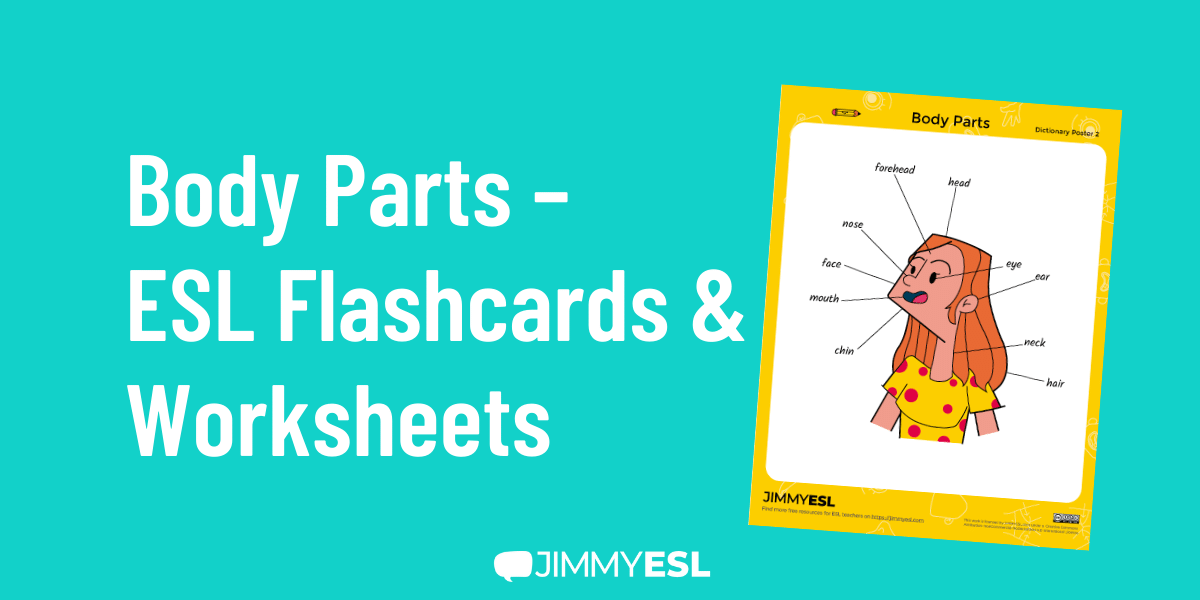
    Body Parts – ESL Vocabulary Worksheets & Flashcards

    Teach the body part names to your learners – with our lovely illustrated ESL worksheets and flashcards, exclusively from JIMMYESL.

    Kids – and likely adults, too – will love the illustrations and thus will be highly motivated to learn the new vocabulary and to complete the exercises in the worksheets.

    Reward your students with a personal Certification of Achievement after taking the lesson!

    Please leave a comment below if you like it!

    Body parts – flashcards and worksheets for ESL lessons

    License Info

    Worksheets: Use them for your lessons and share them with your fellow teachers. Details: Creative Commons Attribution-NonCommercial-NoDerivatives 4.0 International License

    Illustrations: All rights reserved. Please contact us if you want to use them.

    Free Worksheets Package

    The free, downloadable and printable worksheet package includes the following resources:

    • Dictionary Poster
    • 32 Flashcards
    • Worksheet “Missing Letters”
    • Worksheet “Assign the Items”
    • Certificate of Achievement

    Scroll down to get a detailed list of the included resources.

    Body Parts: The List

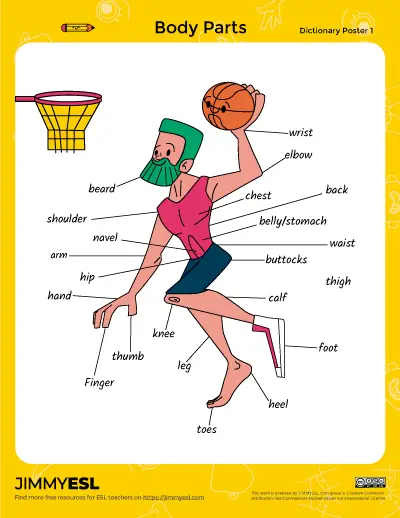
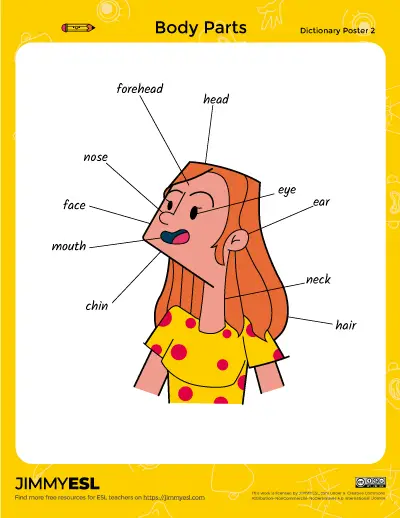
    The free worksheets include the vocabulary for these 32 body parts:

    Head

    I have a big head.

    Face

    He has a handsome face.

    Hair

    She has long hair.

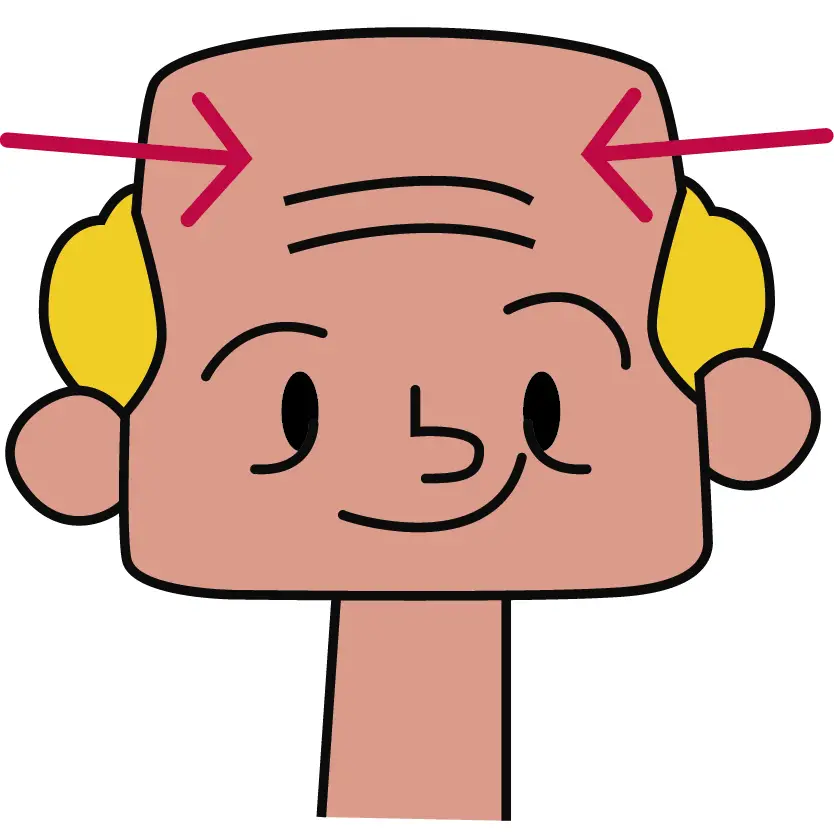
    Forehead

    He tapped his forehead.

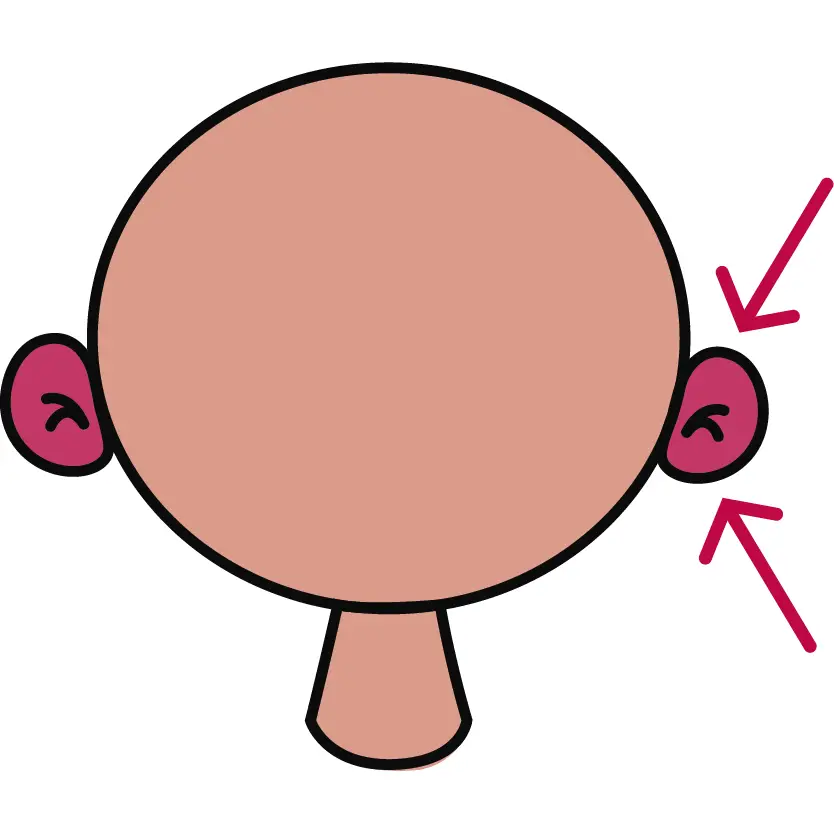
    Ear

    My ears are cold.

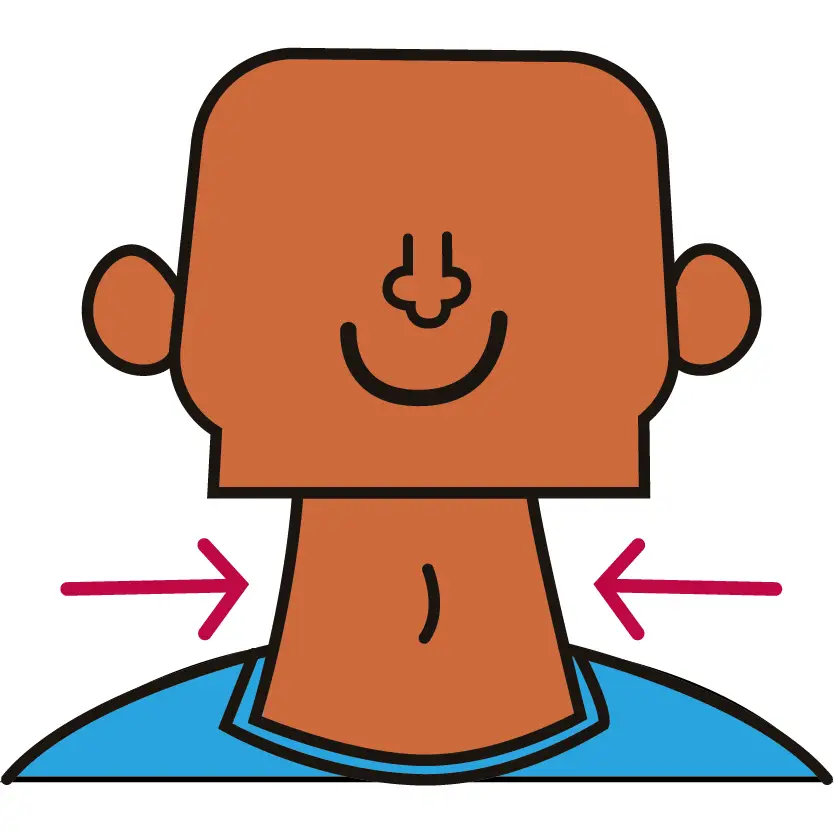
    Neck

    I have a pain in my neck.

    Nose

    She has a small nose.

    Eye

    I have blue eyes.

    Mouth

    My mouth has one tooth.

    Chin

    He has a wide chin.

    Beard

    I have a bushy beard.

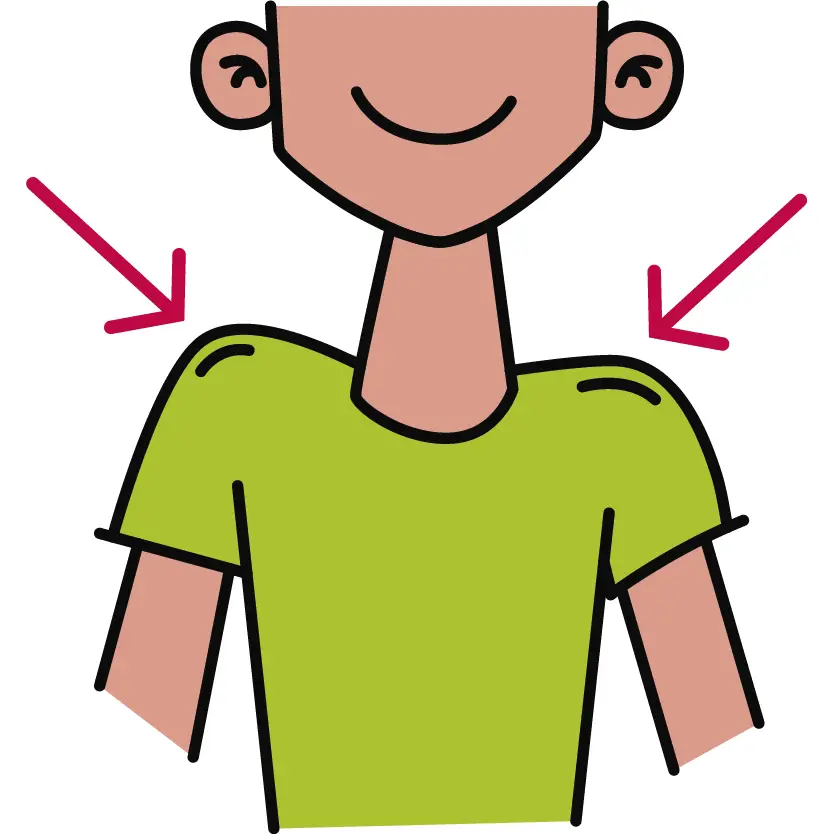
    Shoulder

    He has broad shoulders.

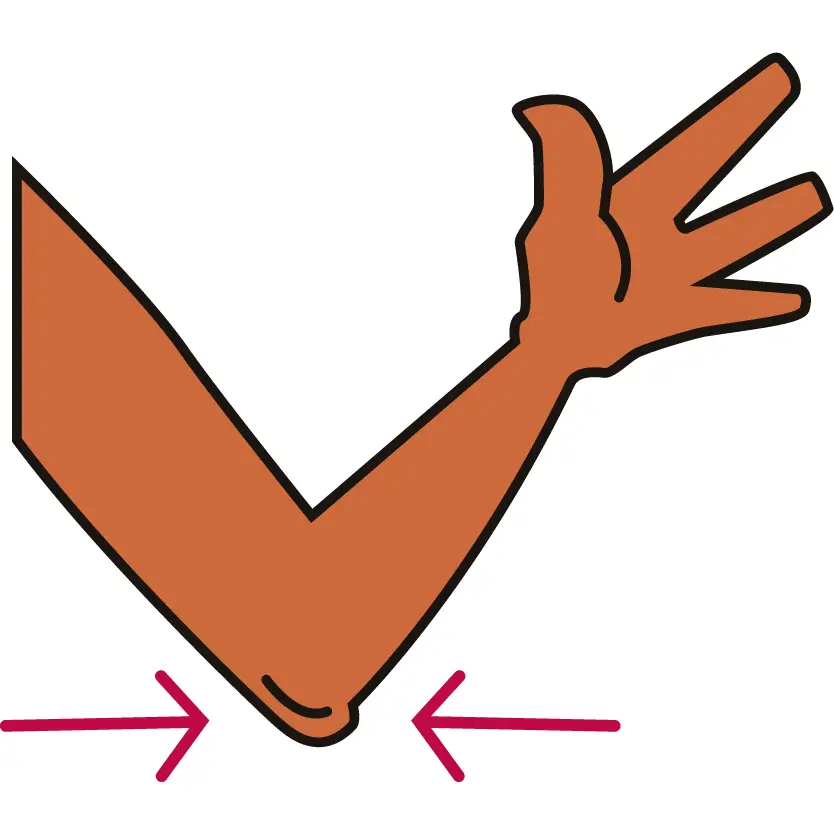
    Elbow

    I hurt my elbow.

    Arm

    She has strong arms.

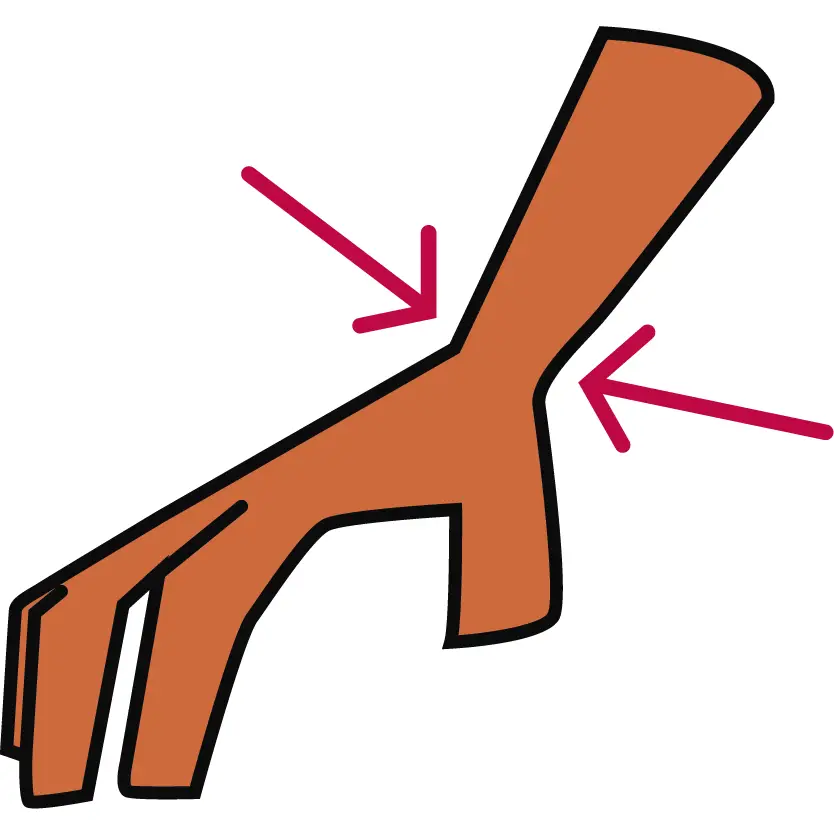
    Wrist

    My wrist has cramp.

    Hand

    I have two hands.

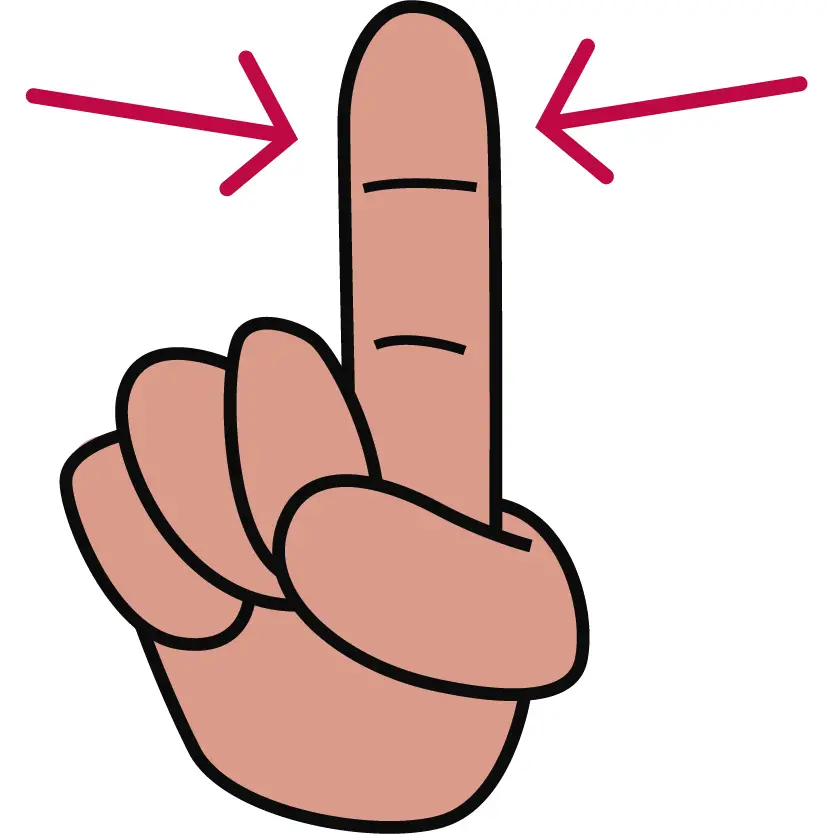
    Finger

    I count using my fingers.

    Thumb

    She gave a thumbs up.

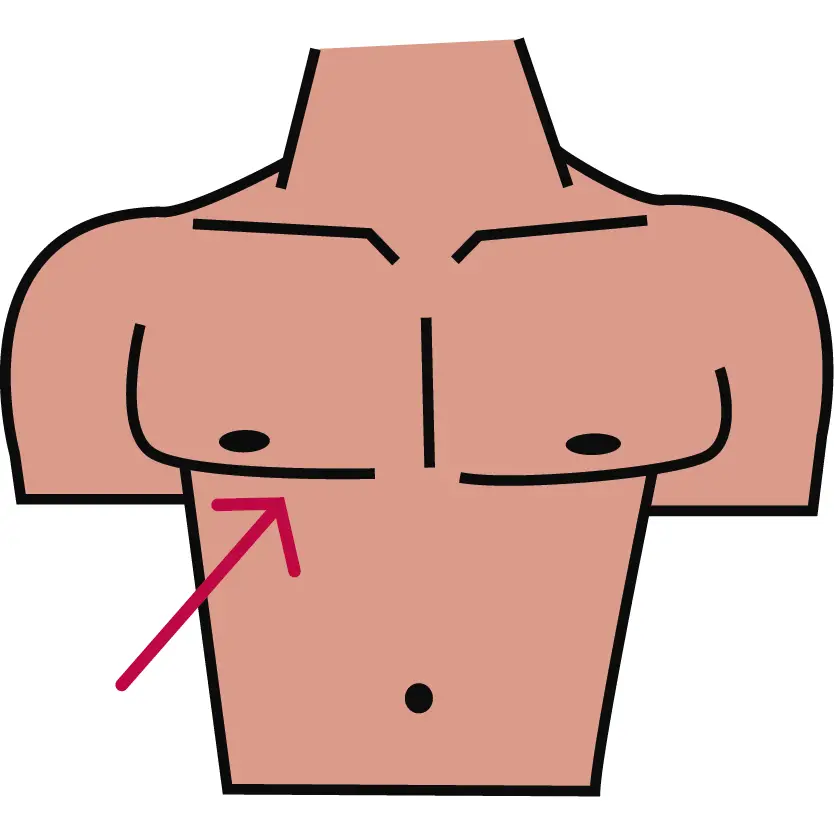
    Chest

    He has a wide chest.

    Navel

    My navel is ticklish.

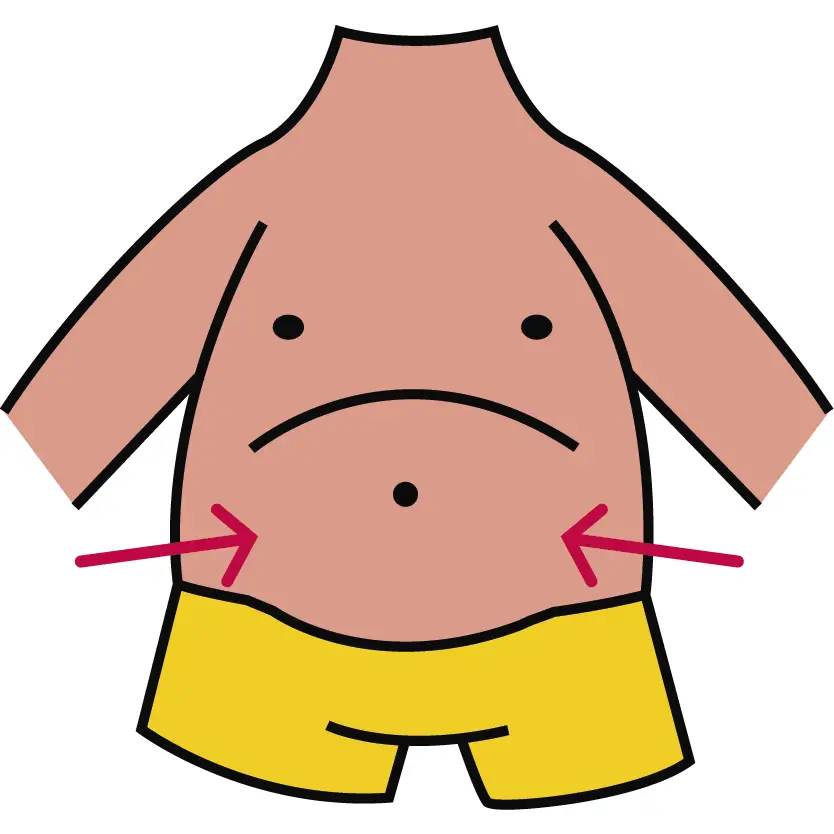
    Belly / Stomach

    I have a big belly.

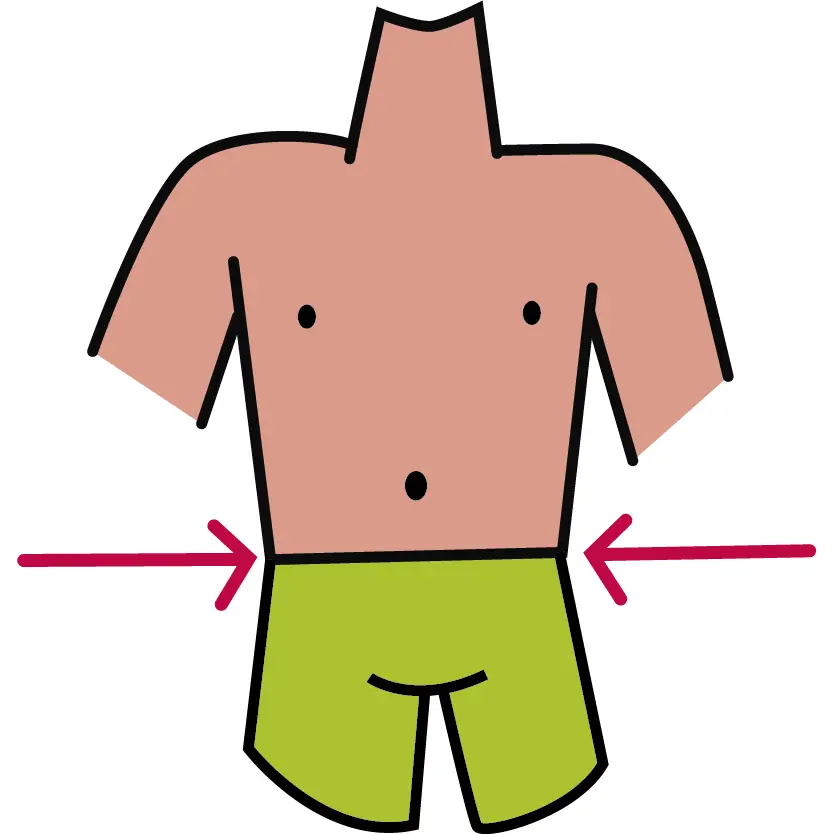
    Hip

    He has wide hips.

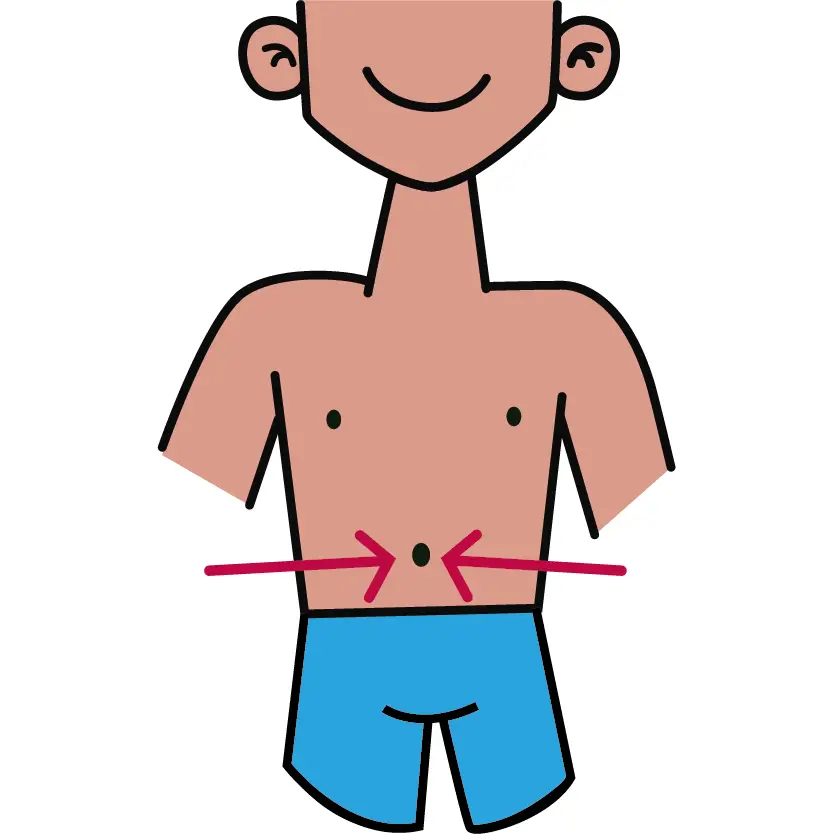
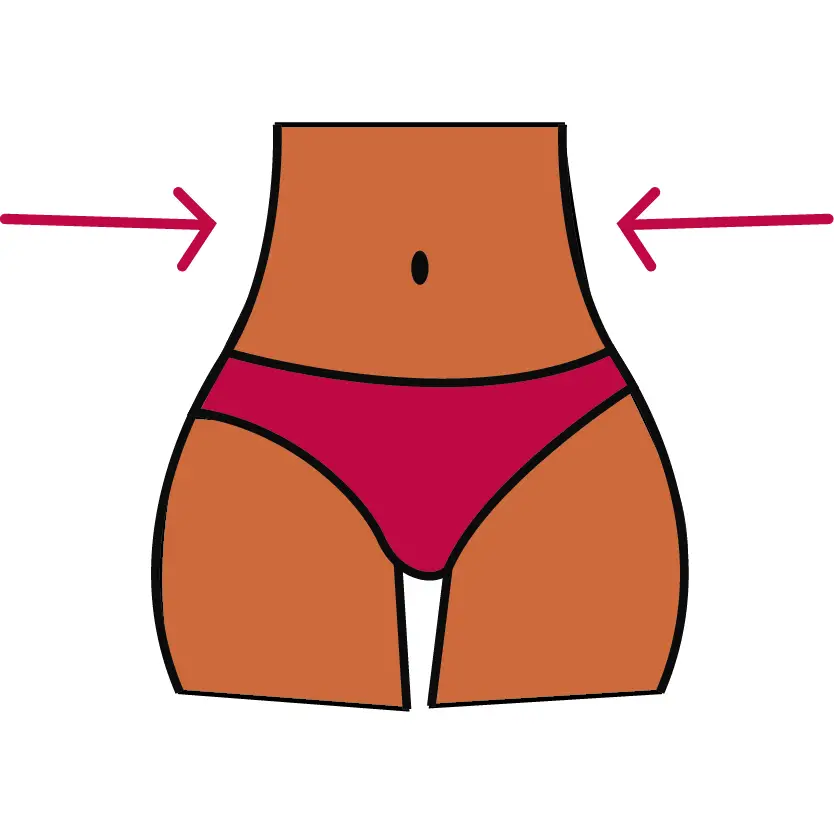
    Waist

    She has a slim waist.

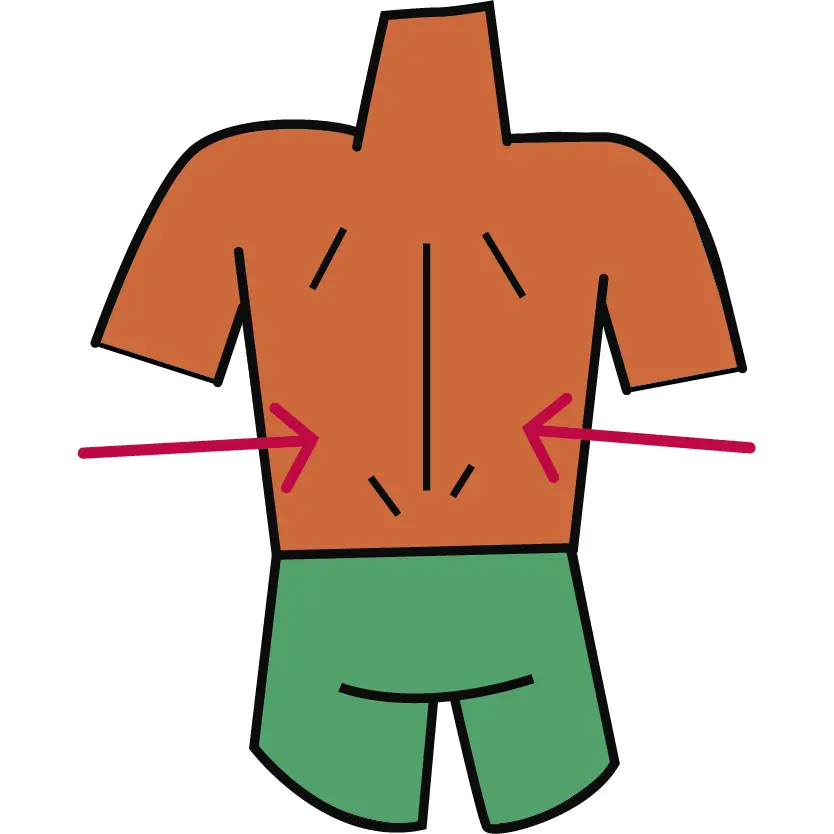
    Back

    Don’t hurt your back.

    Leg

    My legs are tired from walking.

    Buttocks

    I sit on my buttocks.

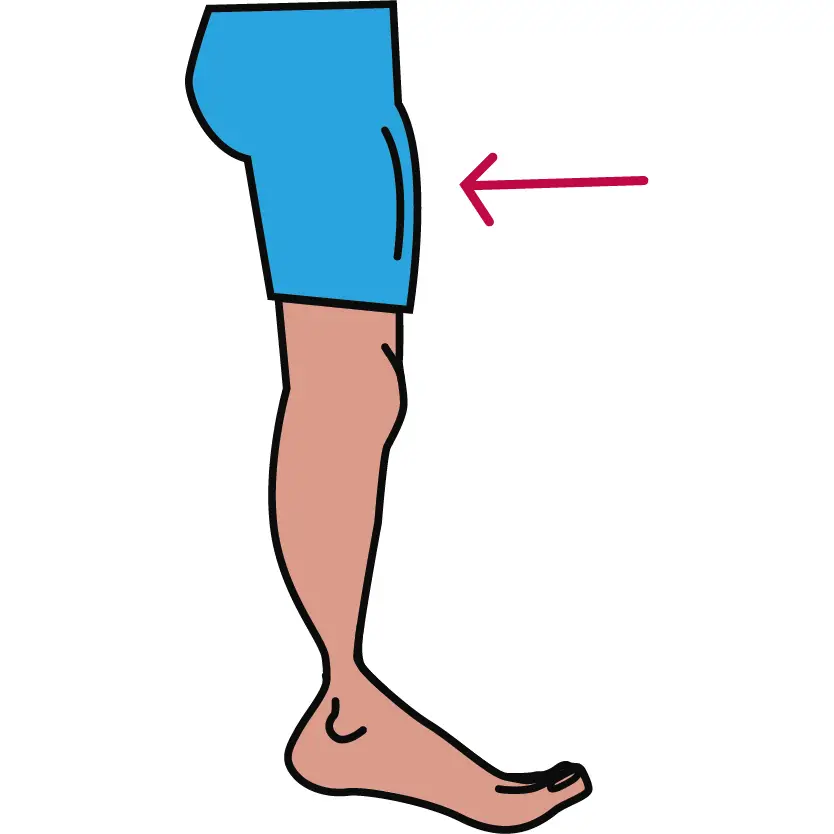
    Thigh

    His thighs are toned.

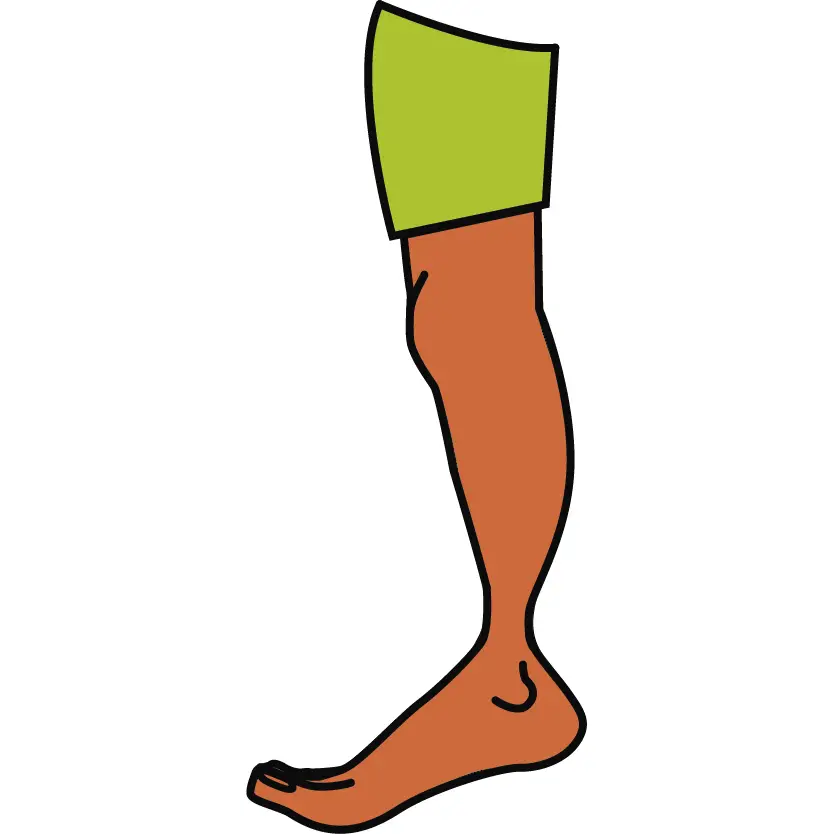
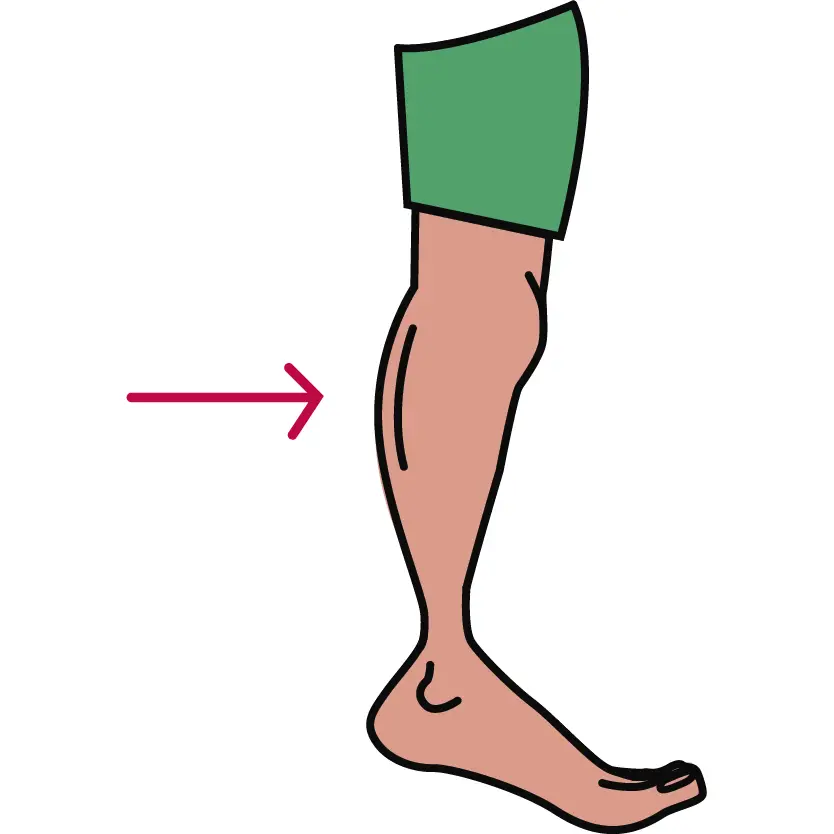
    Calf

    My calfs ached from walking.

    Foot

    I have two feet.

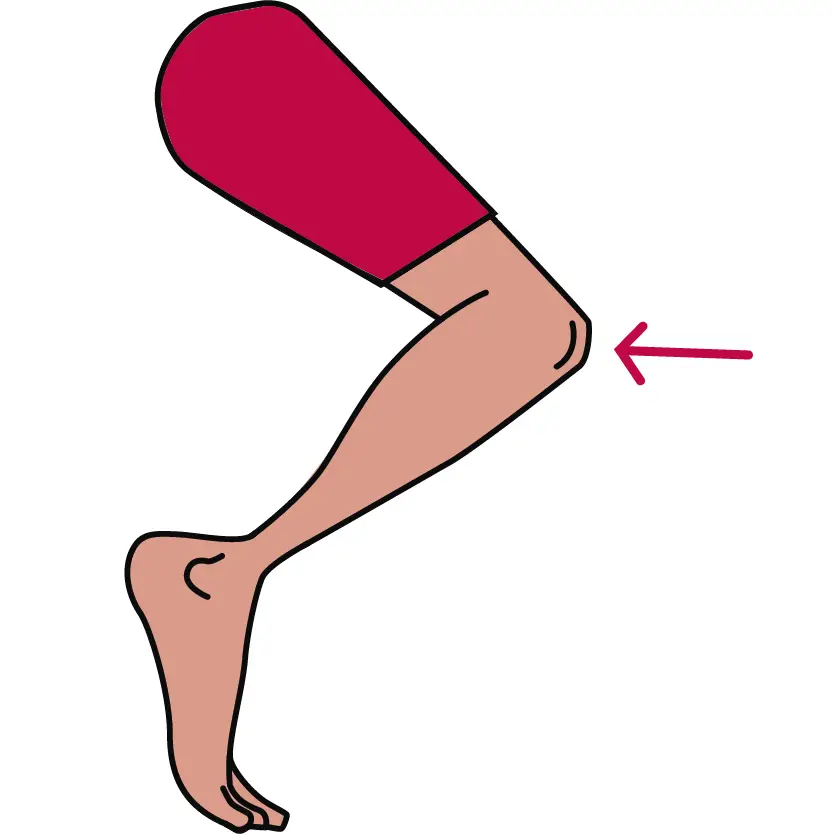
    Knee

    She has pointy knees.

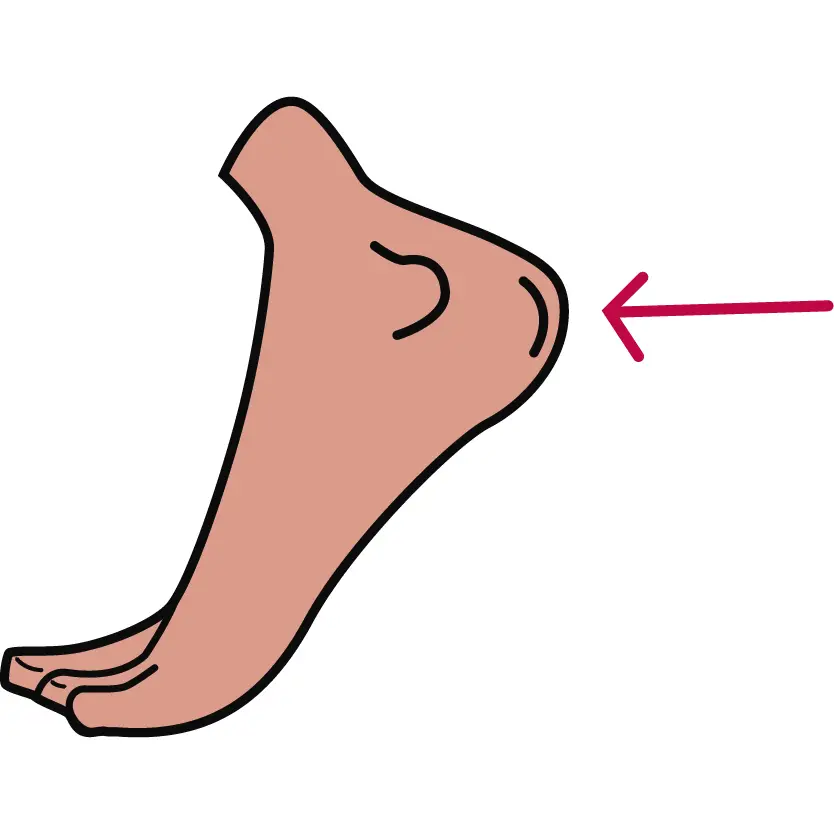
    Heel

    The heel is very hard.

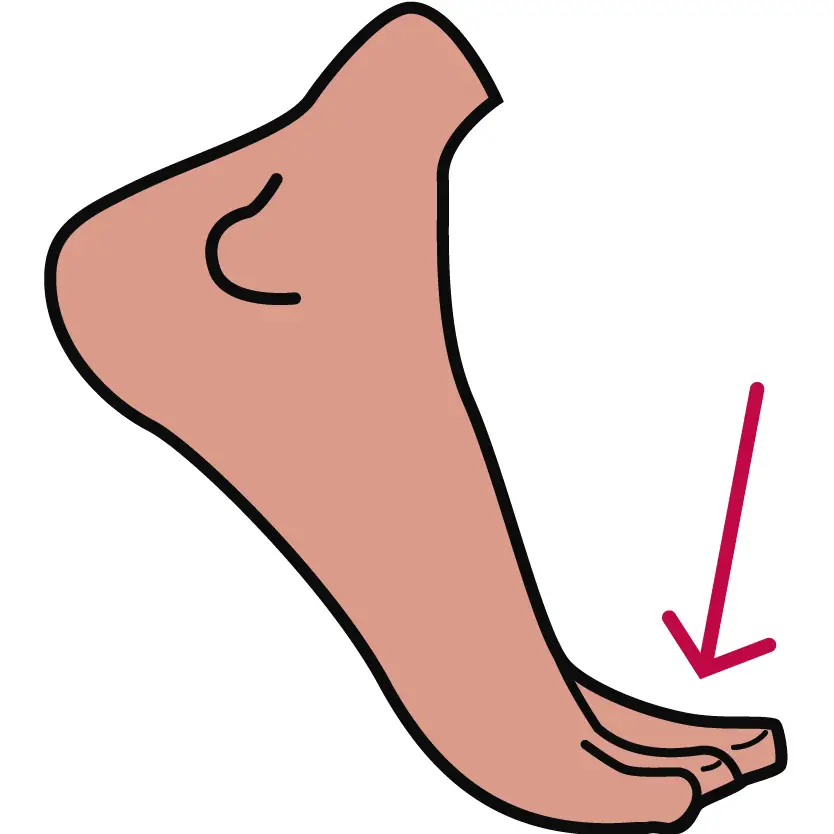
    Toe

    I’m taller when I stand on my toes.

    Body Parts: The Worksheets

    Dictionary Poster

    The Dictionary Poster lists all 32 names of the body parts. Print it and attach it to your classroom wall! – 2 pages

    Poster Page 1
    Poster Page 2

    Printable Flashcards

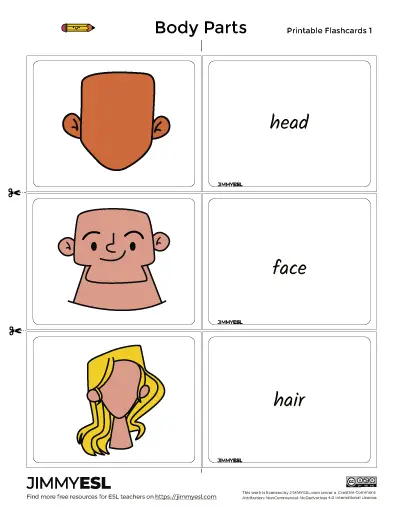
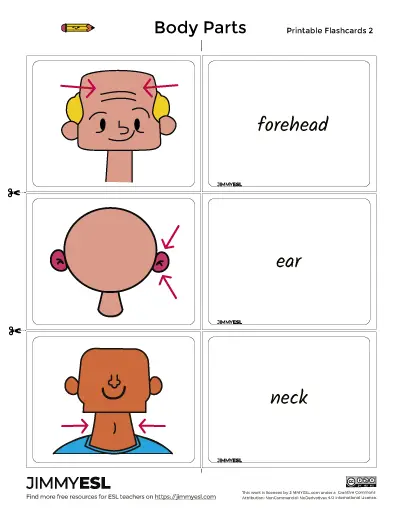
    Teach the body parts vocabulary with flashcards. – 32 flashcards

    Printable Flashcards Page 1
    Printable Flashcards Page 2

    Worksheet: Missing Letters

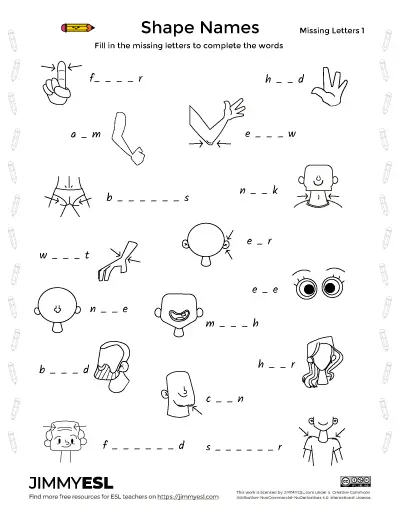
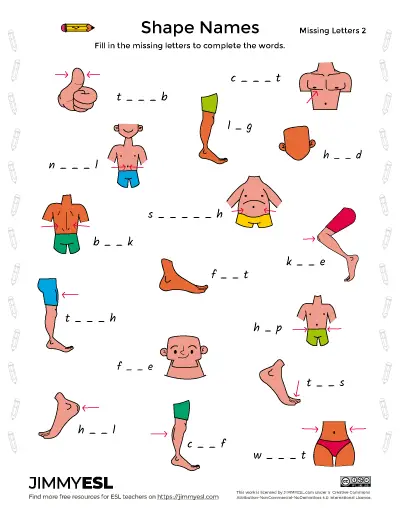
    Let your students fill in the missing letters to complete the names of the body parts and color in the illustrations. – 2 pages, colored and black & white to color in

    Black & White Worksheet Page 1
    Colored Worksheet Page 2

    Worksheet: Assign the Items

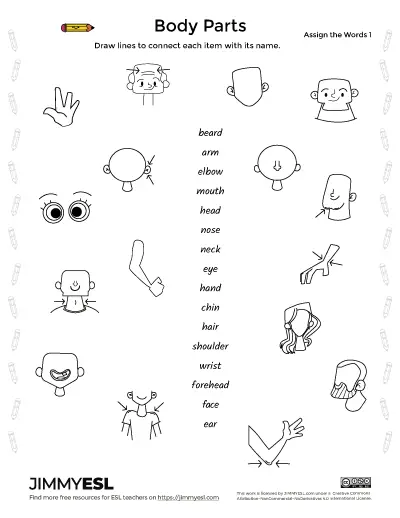
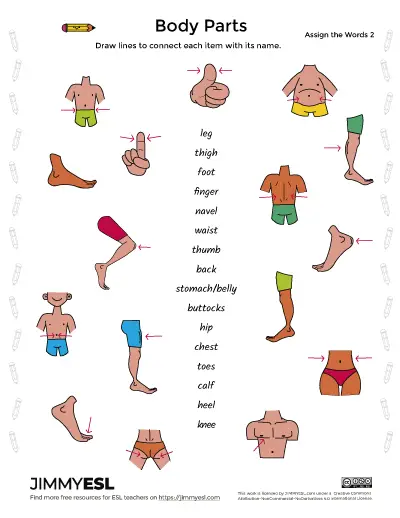
    Let your students assign the body parts to their names by drawing lines. – – 2 pages, colored and black & white to color in

    Black & White Worksheet Page 1
    Colored Worksheet Page 2

    Certification of Achievement

    Reward your students for their effort with a personal printable certification. – 1 page

    Certificate