

Most learners have met thousands of English words and can actually use a few hundred of them. That gap is a method problem, not a memory problem. A word written once in a notebook with a translation beside it, revised the night before a test, is almost designed to be forgotten: it never gets used, it never comes back, and it is stored alone instead of with the words it normally travels with.
This worksheet teaches the method rather than a topic. Four habits decide how much vocabulary a learner keeps, and this sheet makes each one concrete.
Worksheet preview

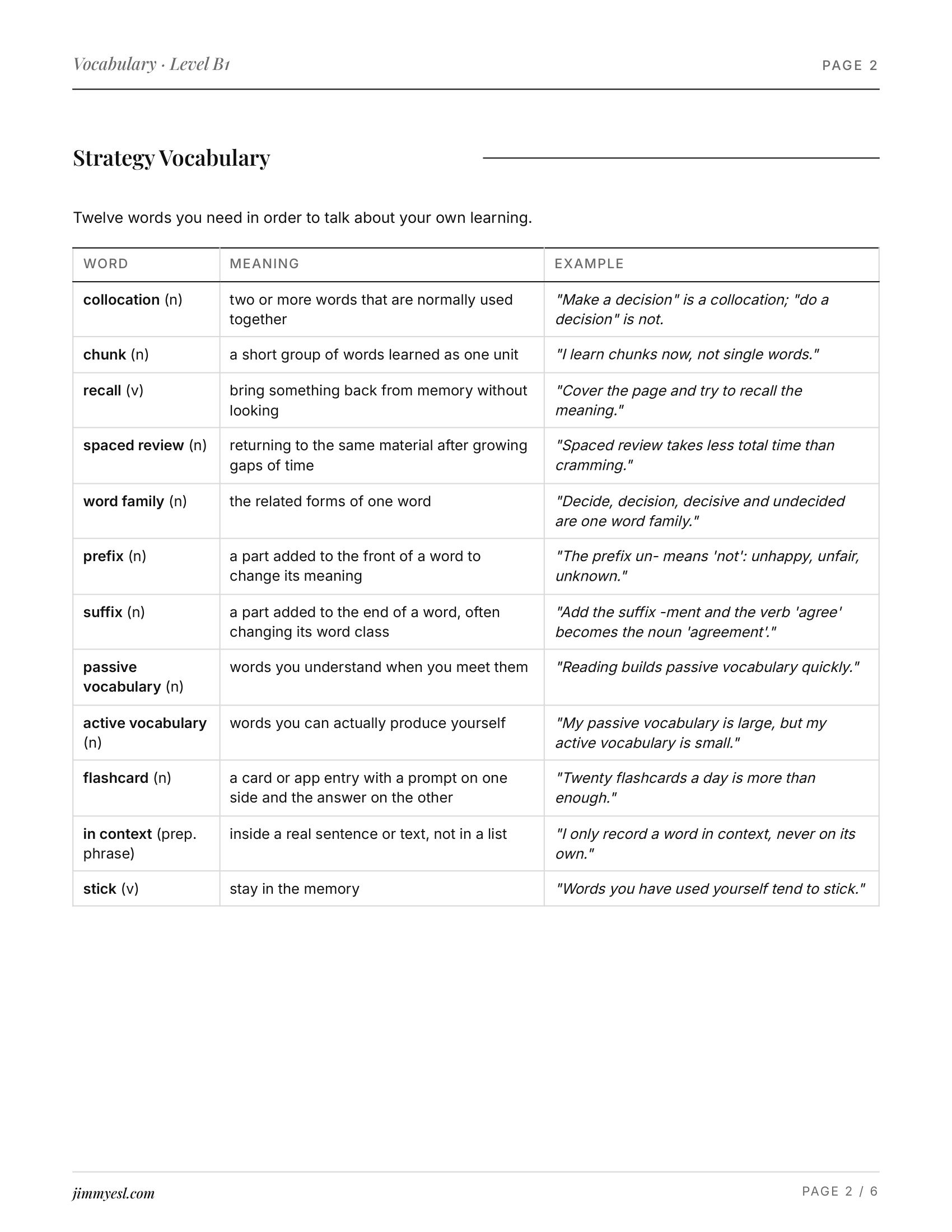

What’s inside:
- A reference panel covering all four habits (learn chunks, space the review, recall rather than reread, use it within 48 hours) with the reason each one works
- Twelve items of strategy vocabulary so learners can talk about their own learning: collocation, chunk, recall, spaced review, word family, prefix, suffix, passive and active vocabulary, flashcard, in context, stick
- A carrier text interviewing three learners who run three different systems
- Comprehension check (True/False/Not Mentioned)
- Match the strategy to the problem
- Fix the Notebook: rewriting five weak vocabulary entries into usable ones
- Word families with prefixes and suffixes, including the three different negative prefixes
- A personal two-week plan, a real message to write, and discussion questions
- Full Answer Key plus Teacher Notes
Common challenges: the collocation habit is the one that pays off longest. Learners who record “decision” on its own go on saying “do a decision” at B2 and even C1. Learners who record “make a decision” never start, because almost no language maps make, do, take and pay onto English the same way.
For: Adult and teenage learners (14+) at CEFR B1. It works as an A2 to B1 bridge lesson if you drop the word-families exercise. Best taught early in a course and then revisited, because the final exercise asks every student to write a real two-week plan and that only pays off if someone checks it two weeks later. Pairs with Context Clues: Guessing Meaning from Context, which handles intake where this one handles retention.
Every worksheet you'll ever need — ready to teach.
Stop building from scratch. 386 classroom-ready worksheets, every level, with answer keys and teacher notes on every sheet.
Leave a Reply