Tag: teo_top_right

  • Equipment Needed for Teaching Online: The Buying Guide

    Equipment Needed for Teaching Online: The Buying Guide

    So, you’ve decided that you want the freedom to teach online, from anywhere, great!

    But what supplies exactly do you need to get started? How much do you need to invest? There is so much equipment and different brands to sift through, what a potential headache!

    Luckily, we’ve put together the essential list of what you need to get up and running, from hardware to software and everything in between.

    Let’s get started with our list of the equipment you really need for teaching online.

    Equipment for Teaching Online: all You Need

    Interview: What Equipment do you Need to Teach Online?

    First, say hello to Harold. Owing to his IT skills and background, he was hired in 2018 by ALO7 to provide IT support to its many online ESL teachers based in USA. This is a secondary role he is tasked with in addition to teaching online for the company.

    Harold has troubleshooted hundreds, if not thousands, of technical issues with online ESL teachers and their equipment. This gives him a unique perspective into what type of equipment online teachers use, what works well, and what to avoid.

    In this 25-minute video interview, Harold talks about everything you need to teach online. He covers a range of equipment and other technical aspects, including: computer, internet requirements, headsets, webcams, green screen… and some others aspects of his life as an ESL teacher.

    Desktop Computer

    It goes without saying that you will need a computer to teach online. While many online teachers use laptops, we recommend investing in a desktop computer instead.

    Desktops are not only more cost-effective than laptops, but they are far more easily upgradeable, and thus have a longer lifespan. The temptation to buy a laptop to teach online will be high, but the cost of owning a laptop will be much higher, over time.

    There may be other reasons to own a laptop, though. So, be crystal clear about your specific goals with online teaching, and decide what’s perfect for your use case.

    You need to make sure the computer you buy ticks certain boxes. Let’s look at those minimum requirements:

    Computer Requirements

    • Hard drive: 128 GB or more, to store lesson plans, files, videos, etc.
    • Memory: 8 GB or more
    • CPU: Intel i5 or higher

    Don’t save at the wrong end. Live video conferencing eats up a lot of memory and processor power, so having a powerful computer is vital.

    Read our guide on the best computers for online teaching.

    Laptop Computer

    Laptops are extremely convenient as they don’t require much space and are portable, so you could theoretically teach from anywhere!

    If these advantages outweigh the cost advantages of a desktop computer, a laptop is right for you.

    However, if you want to save some time and mental energy then no worries, we’ve rounded up a list of the best computers for teaching below:

    Budget Laptop

    Don’t let this low price tag fool you, the Acer Aspire 5 is powerful and solid enough to give you the performance you need in your online lessons. Not only that, the widescreen will make it easy to arrange your windows mid-class, keeping you stress-free and in control.

    2021 Newest Acer Aspire 5 Slim Laptop

    [asa tpl=”flat_box_horizontal”]B08WX9M8GP[/asa]

    Premium, Ultra-portable Laptop

    This is the laptop for those who are on the go. It’s thin and light, versatile (can be used as a laptop or tablet) and it comes with LTE, meaning you don’t need to worry about getting disconnected from the Wi-Fi mid-lesson!

    Microsoft Surface Pro 8

    [asa tpl=”flat_box_horizontal”]B09DJSF748[/asa]

    Read our in-depth guide to selecting a laptop for online teaching if you want to dig deeper.

    Headset

    Most online ESL companies require their teachers to wear a headset, and many of these companies expect their online teachers to wear a headset that has a boom mic.

    This is partly due to the expectation that wearing a headset with a boom mic provides better audio quality; but also partly because wearing one makes you look like a professional online teacher in the eyes of the company and students.

    Fortunately, a good wired headset with boom mic should not cost you more than $50, and there are many options to choose from. High-quality Bluetooth headsets will cost you more, somewhat above $100.

    Don’t buy cheap ones: They’ll easily break, or they have poor sound quality which is a no-go for online teachers.

    We’ve again done the research for you already, and rounded up the top 3 headsets used when teaching English online. So relax, pick the one that feels right for you and get teaching!

    Wired Headset

    Plantronics Blackwire 3320 Wired Headset with Boom Mic

    [asa tpl=”flat_box_horizontal”]B085D7KPFT[/asa]

    Bluetooth Headset

    Jabra Evolve 65 MS Wireless Headset

    [asa tpl=”flat_box_horizontal”]B00ODRSN0A[/asa]

    For a broader selection, check our guides on buying headsets for online teaching, as well as microphones for online teaching.

    Fast and Reliable Internet

    A fast and reliable Internet connection is a must for online teaching. Your Internet connection largely depends on the service quality in the area where you live, but for the majority of online teachers working from home, this will not be too difficult a requirement to meet.

    Still, a few things you need to ensure about your Internet connection is that it meets the online ESL company’s minimum upload and download speeds, but also has a low ping rate (latency). Generally, you should be aiming for upload and download speeds of 10Mbs or higher, and a ping rate less than 100ms.

    Some online ESL companies also require their online teachers to use a wired connection, because connecting to the Internet with an Ethernet cable generally means a faster, more stable connection.

    Read our complete guide to meeting Internet requirements for online teaching here.

    Webcam

    Modern laptops include a built-in webcam which saves you a lot of hassle in this area, phew!

    But… what if you are using a desktop computer which doesn’t have one? What if your employer requests a separate, external webcam (I’ve had it happen before), or maybe you just want to provide extra quality videos to your students. What then?

    No need to make many words here: We’ve been using this Logitech webcam for years, and it flawlessly does its job.

    Logitech C920x Full-HD Pro Webcam

    [asa tpl=”flat_box_horizontal”]B085TFF7M1[/asa]

    Online Teaching Software

    Ok, now you’re set up with all the hardware needed to teach, but what do we need software wise?

    If you teaching company does not provide an own teaching platform, you will need to use one of these video conferencing tools:

    Good Lighting

    Because you are teaching online, lighting plays an important part at your workstation. Some online ESL teachers go overboard with their lighting setup, but in truth, your lighting setup does not need to be elaborate or expensive.

    At a very basic level, you can do well with one or two inexpensive LED desk lamps and position them to get the best illumination on your face and body. Your aim is not to glow in the dark here, but rather to ensure your students can see you clearly.

    The positioning of your lights is just as important as the brightness of your room. We recommend LED lights for most online teaching setups because they don’t emit as much heat, last longer, and are generally brighter than other types of lights.

    Some LED lights also give you the ability to adjust the light temperature between cool and warm colors; this is especially useful if you intend to use a green screen while teaching online, but also not a bad feature to have for just about anyone teaching online.

    See our recommended LED lights for online teachers here.

    Chairs

    You’re all set for technology now but what about your office?

    Maybe you already have a comfortable set-up which you can use; if so, then this is the area you can save a bit of money.

    However, bear in mind that you will sit in your office chair for (hopefully) many hours of the day. It needs to be comfortable and appropriate for your teaching style.

    Your chair should provide exceptional support for your back and neck, meaning that an investment in this chair now will result in not paying out to a chiropractor 6 months from now!

    Once again, we’ve selected a recommendable mid-range priced option for your, saving you the hassle!

    Komene Ergonomic Office Chair

    [asa tpl=”flat_box_horizontal”]B091MS2XMC[/asa]

    Read the full guide about comfortable chairs for teachers.

    Props and Teaching Aids

    Once you have the essentials out of the way, don’t be afraid to spruce up your teaching space. These things, while cheap, offer a massive boost in presentation which your students will certainly appreciate.

    Your props should be relevant to the age group of the ESL learners you teach, and should provide opportunities to elicit responses and encourage interaction from your students. They can also be excellent for warm-up activities, showing and telling activities, and games.

    Online ESL teachers should be equipped with props and teaching aids, including:

    • Puppets
    • Soft toys
    • Play food
    • Flash cards

    We’ve put together a helpful list of the best teaching props.

    Green Screen

    Although a green screen is not a necessary piece of equipment for teaching online, having one can make a huge difference to your virtual classroom as well as student engagement.

    With advances in technology, software is getting better at layering your background with images and videos, without having to use a green screen. But it’s not yet perfect, and a green screen still gets you better results for the time being. Besides, they are an inexpensive investment for the value they bring to your online classroom professionalism.

    Read our guide to learn how to buy and use a green screen in an online classroom here, and how to use ManyCam.

    Conclusion

    Now you have everything you need to teach online!

    Hopefully, you should already have some of these things on hand which leaves you with only a few things to pick up. After that it’s a case of gaining experience and establishing yourself as an online guru!

    The next step is to check out this guide on creating your first lesson plan.

    Good luck and happy teaching!
  • Is Teaching English Online Worth It? The Pros & Cons

    Is Teaching English Online Worth It? The Pros & Cons

    Teaching English online from home sounds great: Making money without leaving your home, deciding on your schedule, meeting new people and engaging them in conversations… too good to be true?

    On the other hand, I’ve almost never heard of a teacher who became rich, and many complain about being stressed or even burnt-out.

    So, if you consider stepping into an online ESL career, the question is legitimate: Is teaching English online worth It?

    In this post, I am going to weigh the pros and cons of four aspects of this career – the final verdict is up to you then.

    Is Teaching ESL Online Worth It? Pros & Cons

    Is Teaching English Online Even Legit?

    Perhaps before we even delve into the pros and cons of teaching English online, we should clear up any doubts about it:

    Teaching English online is a legitimate, viable way to earn an income. People are teaching English online, both part-time and full-time.

    We don’t suggest anyone to quit their current job to pursue a career as an online ESL teacher, but we can recommend it as a way to supplement or diversify your income streams. That’s not to say it can’t develop into something more. Indeed, some online ESL teachers found their way into full-time careers in online ESL.

    Teaching English online is a good option for people who have seasonal jobs, are freelancers, or bootstrapping a startup. Even for those who don’t need the additional income, teaching English online can be a great way to bring more fulfillment and joy into your life.

    The online ESL industry is populated with school teachers who have made the transition to online teaching: stay at home parents, musicians, artists, career ESL teachers, and world nomads who have discovered they can enjoy a decent lifestyle in countries where the cost of living is relatively low.

    So now that we have cast any doubts about whether teaching English online is legit, let’s examine the opportunity from different angles and determine if teaching English online is worthwhile for you.

    Video Interview: “Teaching ESL Online is the Best Job I’ve Ever Had“

    Michael Wasserstein is an online ESL teacher who lives in Florida. Prior to starting his career as an online ESL teacher, Michael worked as a computer training consultant. But as the market forces in his career changed, Michael found himself at a crossroads that would eventually lead him to the world of online ESL education.

    Michael only works with one company, and he is one of the most popular online teachers in the company. He is also a member of the company’s academic team, enabling him to enjoy a near full-time schedule in online ESL.

    Making Money as an Online ESL Teacher

    People who enter the online ESL industry don’t do it to get rich. You probably won’t get rich teaching English online, either. However, not everyone has the opportunity or fortune to earn fantastic salaries or launch a successful, multimillion-dollar startup.

    The fact of the matter is, for many people, searching for an online teaching job is a means to making ends meet, or paying down debts. So, let’s be crystal clear that if you’re looking at teaching English online from a monetary perspective, it’s likely because you need to make money.

    Let’s look at the pros and cons and see if teaching English online is worth the money:

    Pros

    The money is real, and you can get hired and start earning in as little as one month. The income can be fairly steady, depending on your popularity and availability.

    Some companies reward top performers with additional work such as recruiting, training, and content development.

    There’s a very low startup cost; you probably have the most expensive cost (i.e., a computer) already covered.

    Because you can do this from home, there are no commuting costs.

    Because most online ESL jobs are offered on an independent contractor basis, some of your expenses may be tax-deductible.

    If you have to travel, you can still teach English online. You don’t have to take days off (unless you really want or need to). So, in essence, you can still make money while traveling.

    Cons

    Though some companies offer rates as high as $50 per hour, most fall in the lowly range of $10 – $20 per hour. Remember, this is pre-tax income, too.

    There’s no fixed income; you get paid per completed lesson, which means you have to be good at maximizing your teaching opportunities by optimizing your work schedule

    While some companies offer 24/7 online classes, most work tends to fall within the early morning and evening hours, mainly due to time zone differences. This somewhat limits your potential to earn more.

    The work can get extremely sparse during holiday and festival periods.

    Your online teaching income is somewhat at the mercy of the Internet gods and freaks of nature. If you lose your Internet, electricity, or your computer crashes, so does your income. Tough luck.

    How Much Can You Expect to Make?

    How much money you earn as an online ESL teacher is going to depend on some factors, but primarily your earning potential will be tightly correlated to your availability to work.

    Some people have a high availability to teach English, and thus have more earning potential. Others look at online ESL teaching as a side hustle, and fit it in or around other work.

    So even though you could potentially make $75,000 per year teaching English online with a company like VIPKid, in reality, the earnings for most online ESL teachers will be lower. Below is a table we have designed to help you estimate your potential monthly earnings based on a $20 per hour rate and 4 weeks per month. Note that these amounts are before taxes:

    Teaching 3 days a week:

    Hours per dayHourly RateMonthly earnings (4 weeks per month)
    2USD 20USD 480
    4USD 20USD 960
    6USD 20USD 1,440

    Teaching 4 days a week:

    Hours per dayHourly RateMonthly earnings (4 weeks per month)
    2USD 20USD 640
    4USD 20USD 1,280
    6USD 20USD 1,920

    Teaching 5 days a week:

    Hours per dayHourly RateMonthly earnings (4 weeks per month)
    2USD 20USD 800
    4USD 20USD 1,600
    6USD 20USD 2,400

    Read our guide on how to make a monthly salary of $4,000 with VIPKid.

    Job Satisfaction

    When it comes to teaching ESL online, the adage “money isn’t everything“ holds true. What you will discover from the broad range of online ESL teachers is that many find the work enjoyable and personally rewarding – and, thus, absolutely worth doing.

    Many could not imagine doing anything else.

    Much of it comes down to being passionate about the work and the difference you make in the lives of your students, but beyond passion, most of it boils down to whether you have the right personality for this job. 

    It isn’t everyone’s cup of tea, and for some, the job may actually feel unrewarding at times. Particularly, if you are introverted and find it uncomfortable engaging with others, this may not be the ideal opportunity for you.

    Let’s have a look at the pros and cons in terms of job satisfaction:

    Pros

    This job is fun if you enjoy interacting with others, and especially if you feel comfortable engaging with young children.

    Though many people feel nervous when getting started with teaching online, teaching online for the most part is not stressful.

    As most lessons are scheduled in the early mornings and evenings, and on weekends, there is a lot of spare time during non-teaching hours to focus on other personal or work priorities.

    Many companies offer incentives and rewards for outstanding performance. For example, some Chinese online ESL companies will invite their top teachers to visit China, all expenses paid.

    Though online teachers work independently of their homes, there isn’t a sense of feeling isolated. You are always interacting with students, and there are numerous channels for online teachers to interact with each other. Some companies have been quite effective at building vibrant communities for their online teachers.

    Because online teachers are essentially independent contractors, that enables them to choose how much they work, work with one or more companies, or split their work between online teaching and other types of freelance work.

    Cons

    If you don’t enjoy interacting with children, this job will not be enjoyable for you. Though there are online classes for adult ESL learners, the largest segment consists of learners between the ages of 6 – 12.

    A lot of the work happens in the early mornings and evenings, so depending on your location, you could be working during hours when most people are still sleeping. Most online ESL classes with Chinese students are scheduled between 6pm – 9pm (China Standard Time), which is 5am – 8am (EDT). If you like sleeping late or sleeping in, this job is not for you.

    Online teaching often involves having a high level of energy and enthusiasm. If you are introverted and have difficulty stepping outside your comfort zone, it may not be a good fit.

    Online teaching is essentially sedentary work. If you have a hard time sitting in one place for several hours, you might feel uncomfortable at times. A standing desk may be a good option in this case.

    Some online ESL companies levy penalties for last-minute cancellations, missed classes, or complaints. For some people, this can be a bitter pill to swallow and detract from the satisfaction that comes with teaching English.

    Some online ESL companies have been known to operate unpredictably or unethically. For example, some companies have changed their terms with short notice, while others have expected teachers to attend training sessions or other work-related sessions without pay.

    Read our guide on how to start your independent English online teaching business.

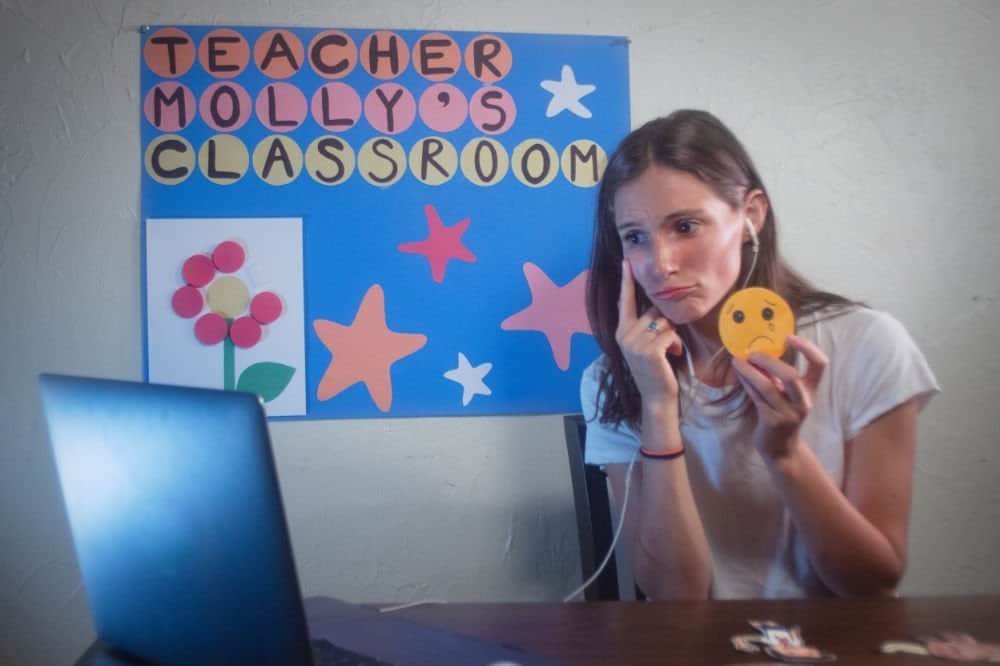
    Teacher Molly givong an online English lesson about feelings.
    Teacher Molly giving an online English lesson about feelings. (Photo: Molly Oberstein-Allen)

    Challenges

    Most experienced online ESL teachers will agree that the job itself is not difficult.

    If you are fluent English, enthusiastic and engaging, and genuinely passionate about teaching and helping your students improve their English fluency, there isn’t anything complex about teaching ESL online.

    However, as with anything, some aspects of being an online ESL teacher can be difficult to cope with. There will be times when you feel frustrated, feeling like it isn’t worth it, and throwing in the towel.

    Based on my experience, though, the pros far outweigh the cons. As long as you have carefully selected who you want to work with, and selected well, the negatives will be a once in a blue moon thing.

    However, decide for yourself; here are the pros and cons again:

    Pros

    If you know English, you can teach English online. Most online ESL jobs are not actually about teaching grammar, verb tenses, or other mechanics of the English language.

    Except for advanced classes such as IELTS preparation, most online ESL classes are about engaging your students in conversational English. This is one job anyone who speaks English can do.

    Most online ESL companies have their own teaching platforms and courseware, so, beyond reviewing the lesson content beforehand, there is practically little to no preparation required to do the job. You basically show up, teach your lessons, teach them well, and finish up.

    Some companies may also require you to complete post-lesson evaluations of your students. Most of these can be completed within minutes, and many companies pay you an additional fee to complete the reports for each lesson

    If you have a computer and a stable internet connection (which you probably do if you are reading this), you can teach English online. Some companies will require you to install some software to perform the lessons, while other companies have developed their courseware to run in a web browser, with nothing to install on your computer.

    Cons

    You will get complaints. There isn’t a person on this planet who can perform at a level of perfection. And even if you deliver what you thought was the perfect lesson, there will be times when a student (or parent) disagrees. You’re going to get complaints just because the student (or parent) does not like you.

    It is a fact of life you need to accept. It is not something isolated to teaching English online, of course. But, as you will be teaching hundreds, if not thousands of online classes over time, you will have to come to grips with it.

    It is never comfortable to get complaints from students or parents, and that’s one of the things that make this job more difficult. If you struggle with receiving complaints, this job may not be for you

    There are going to be times when the staff of the online ESL company will baffle, anger, confuse or disappoint you in some way. Part of this is routine in any type of employment, but another part of it will be rooted in cultural differences in workplace ethics. People in different parts of the world view work obligations differently, interpret and resolve conflicts differently, and have different priorities.

    Beyond the cultural differences, you will likely also experience misunderstandings due to language barriers. There is a good chance that some staff members you have to deal with inside the company don’t have a high level of English fluency. It is ironic, indeed. But it is true. For these situations, you need to be patient and keep your cool.

    Getting Hired to Teach English Online

    As with many things, getting hired into online ESL teaching used to be super easy. If you spoke English, looked like someone who ought to speak English, and had a pulse, you were hired.

    It is still relatively easy, but, as the industry evolves, requirements for hiring online ESL teachers are becoming more stringent. You will need a university degree as well as a TEFL certification for most dependable online ESL teaching positions today.

    Due to new legislation of the Chinese government, since summer 2021, Chinese companies aren’t allowed to offer online lessons given by foreign teachers to Chinese students (residing in China). Before, China was by far the biggest ESL market; as a result, the demand for online teachers tanked.

    However, people are learning English as a second language in almost every country of the world, so there are still enough opportunities.

    If you are a native speaker who is a visible minority, don’t feel dismayed. Things continue to improve on that front. It is difficult to say discrimination in ESL will vanish completely, but take comfort knowing that many visible minorities are teaching English online with a great deal of success. And, some online ESL companies are equal opportunity employers.

    Here are the pros and cons of getting hired into online ESL teaching:

    Pros

    If you speak English fluently and have a university degree, chances are good you will be hired quickly, especially if you are a native English speaker from the US, Canada, UK, Australia, or New Zealand. In most cases, you will need to have a TEFL certification as well.

    If you demonstrate enthusiasm and a high degree of passion when interviewing and performing your demo lesson, there is really no reason why you would not be hired.

    If one online ESL company isn’t hiring, another one is. There are plenty of choices when it comes to whom to work for at the moment. We anticipate some consolidation as the market matures, but for now, you have the pick of the litter, and can even stack up your calendar with lessons from multiple companies.

    Cons

    Native English speakers without a university degree will be challenged to find ongoing work. For those with degrees, this might not be seen as a con, but for those without, it is an unfortunate reality.

    It is harder to get hired if you are a non-native English speaker. Many companies prefer a native speaker to a non-native, and some companies will only hire natives speakers.

    Though it is gradually improving, native English speakers who are visible minorities still face discrimination, not only when applying for jobs, but also from students and parents after they have been hired.

    Wrapping Up: Is Teaching English Online Worth It?

    If you are adaptable, open-minded, and enthusiastic when interacting with people, then teaching English online is entirely worth it.

    It offers you a lot of flexibility that other types of work don’t, and for many people, it is one of the most enjoyable parts of their day.

    You probably won’t get rich teaching English online, but it might open the door to new opportunities you never imagined.

  • Teaching English Online: 18 Best Practices Guaranteed to Increase Your Bookings

    Teaching English Online: 18 Best Practices Guaranteed to Increase Your Bookings

    Every online ESL teacher wants to increase their bookings – but only some teachers have what it takes to consistently fill all their slots.

    If you want to be a top-tier ESL teacher, there are a few things you definitely have to do to max out your bookings and provide consistently good classes.

    Intrigued?

    Here are some best practices you must follow to be an A+ online ESL teacher:

    Becoming a First-Class Online ESL Teacher: 18 Best Practices

    Be Punctual

    Have you ever made plans with a friend only for them to show up 15 minutes late, sweaty and apologizing?

    I bet waiting on them was pretty frustrating. When people show up late we feel annoyed and cheated out of our precious time, and that’s all the more true when we’re paying them.

    As an online teacher, it’s imperative that you’re always ready for the start of class. After all, it’s not like you can act like traffic held you up between your kitchen and the computer.

    Dress to Impress

    Make sure to dress appropriately for your lessons. You don’t have to go all out for your online classes or anything – a clean solid-color t-shirt or sweater and combed hair should generally do the trick.

    Just make sure you look neat, presentable, and professional, and that you obey any company policies regarding appearance.

    Have a Plan

    You should go into every class having an idea of what each part of the lesson will consist of and having materials prepared for each part of your lesson.

    Most teaching platforms give teachers lesson plans, meaning that most of the heavy lifting is done for you – all you need to do is prepare any relevant props and rewards and review the lesson material ahead of class.

    If you’re developing your own lesson plan for class, design a killer lesson plan using our guide and be sure to have backup activities prepared just in case.

    Think Long Term

    If you’re creating your own lesson plans, it’s not enough to think through each individual lesson – you need to think about the arc of each student’s learning over time.

    Your curriculum should help your students build on what they’ve previously learned and solidify new information, and it should be clear to your students themselves how they’re progressing and building toward goals in your lessons.

    Creating curriculum that builds on itself and leads toward tangible goals will help your students learn more, and it will also make students feel more motivated and confident in their learning.

    Pick the Right Material

    It’s important that your lessons are tailored to your students: that they’re tailored to their age level and ability, of course, but also that your lessons speak to your students particular interests.

    For example, if you’re teaching a student who’s obsessed with trains, you could have them read passages about trains, use trains in examples, or use toy trains as rewards.

    Choosing material that matches your students will help them feel more engaged, which will in turn help them learn more.

    Use Quality Gear

    You don’t need a trillion dollar laptop and space age headset to teach online – after all you’re holding English lessons over video call, not commanding the Hubble Space Telescope.

    You do, however, need a setup that’s reliable and sturdy. You don’t want your laptop dying halfway through a class or your microphone crackling while you’re trying to teach, for example.

    Investing in some decent teaching equipment now will save you headaches and potential embarrassment down the line.

    Speak to Their Level

    How quickly you speak, how much you enunciate, and what kind of vocabulary you use should all be dictated by the level and ability of the student you’re teaching.

    If you’re teaching total beginners, it’s important to speak slowly and clearly, enunciate each word, and use simple vocabulary that they can understand. It’s important to accommodate your students as they develop their listening ability and build a foundation in English.

    With more advanced students, however, you should speak more as you normally would, so they can get accustomed to engaging in English conversation in the real world.

    After all, never learn how to ride a bike if you don’t take the training wheels off at some point!

    Don’t Miss Classes

    Everyone misses class once in awhile: emergencies arise, power outages and wifi mishaps occur, and sometimes that pesky alarm clock just doesn’t go off. 

    When unavoidable hiccups happen and you just can’t make it to class, don’t worry: your students and the people you’re contracting with will understand. After all, they’re human too.

    However, it’s super important to not make a habit of missing classes.

    Doing so will make you seem unreliable and uncommitted, and it’ll give you less leeway if and when you have to miss class for legitimate reasons.

    Handle Cancellations Well

    Over the course of your teaching career, students will occasionally miss class (or show up late).

    If you teach for a platform like VIPKID they’ll help you handle lateness and missed classes, but if you teach independently you should have a firm policy in place so that students know the consequences of cancellations in advance.

    You can of course be lenient with students and evaluate cases according to each student’s track record and their unique situation.

    You don’t, however, want to be stuck arguing with students about whether they owe you payment after they cancelled class 5 minutes before it was supposed to start for the third time in a row.

    Have a Backup

    You don’t want to be caught with a malfunctioning headset at the start of class, and you want a poor wifi connection even less. 

    Having good supplies is key to creating smooth lessons – check out this buying guide if you’re looking to upgrade your classroom.

    Having extra supplies on hand is even better.

    Investing in a backup pair of headphones, a backup computer charger, and perhaps an ethernet cable or some other alternate means of connecting to the Internet will help you ensure that every class goes off without a hitch.

    Hone Your Technical Know-How

    You’ll need to troubleshoot problems on your end during class, sure, but your students will also doubtlessly run into problems with your teaching platform. 

    Knowing enough about the platform and basic computer info to help a student restart their router, reload the webpage, unmute themselves, or angle the camera to their face will save you time and a headache. 

    And you’ll appreciate not having to call for an intermediary every time a small problem arises.

    Create an A+ Environment

    The most important components of a great classroom environment are a private, quiet area to teach in and good, bright lighting.

    Once you have those components, you can start worrying about cutesy backgrounds and props.

    But in the end, it doesn’t matter how many killer teaching tools you have if your student can barely see them, or if there’s so much background noise that it’s hard for them to hear you.

    A bright, quiet teaching environment is key.

    A green screen will let your online classroom even look more professional.

    Teach With a Smile

    When you smile, you come off as friendlier and happier, which will make your students feel more at ease in class and in turn encourage them to feel more comfortable taking risks and speaking more.

    You don’t need to ham it up as much with older students as with younger students, but a pleasant demeanor will go a long way with students of any age.

    And the more you practice smiling during class, the more it will come naturally to you!

    Use Props

    Props are a relatively inexpensive investment that make a huge difference in the quality of your lessons.

    They can add a bit of fun to class, which helps engage younger students especially. They can also help you easily explain concepts that might otherwise be difficult to convey.

    Whiteboards, flaschcards, and “realia” (i.e. using a real or plastic apple when you’re discussing fruit) are all great props. You might also invest in a puppet to demonstrate dialogue or a toy microphone to signal who should be speaking when.

    Props don’t just add fun to lessons – they also show that you’ve put thought and preparation into your lessons.

    Check our list of great props for ESL teachers.

    Set – And Check – Your Schedule

    I’ve had more than my fair shares of scheduling mishaps – forgetting I have a class scheduled until five minutes before it starts, running home to make it to class on time, or showing up a minute late to a class I totally blanked on.

    Now, I’m totally on top of my class schedule.

    I double check my schedule for the following day every night before I go to bed and close any early morning slots that haven’t been booked because I know I’m not going to wake up to check to see whether I had a short-notice booking at 4:30 am. 

    I also check my teaching schedule anytime I schedule something, closing bookings the morning after I plan on going out or on travel days and not scheduling activities if I already have classes booked.

    Managing your schedule like this will become second nature once you’ve been teaching for awhile, but it’s important to start cultivating these habits early.

    Assign Homework

    If you teach with VIPKID or a similar company, you don’t need to worry about this step! The teaching platform will assign homework and the student’s learning partner will check it – all you have to do is teach class.

    If you’re teaching independently or through a tutoring marketplace, though, you’ll want to assign homework to help your student concretize the information they’re learning and progress faster.

    Homework also helps your students come to class more prepared, which makes lessons go more smoothly, and it gives students a sense of control and accomplishment.

    Stay Up-To-Date

    Join forums, message boards, and Facebook groups (like ours!) to stay up-to-date on the latest teaching developments.

    Being ahead of the curve will help you teach effectively and stay in demand!

    Just Keep Chugging!

    If you take these tips to heart, you’ll be on your way to getting full bookings in no time.

    And if you’re looking for more tips about how to up your online teaching game, no worries – here are even more ways to be the best online ESL teacher ever.

    And remember: you’re on your teaching journey and you’ve made mistakes along the way, don’t worry! Everyone has missteps while they’re learning, including your students – and including you.

    The more classes you teach, the more you’ll learn how to prepare and make every class a smash hit.

    Interested in teaching English through VIPKID? Click my referral link and apply today!

    Need a new computer for teaching online? Read this guide.